Walking three abreast in single-file paths
TL;DR
- Walking side by side is fine until the path is too narrow to let others pass. Then the group, not the oncoming walker, should adjust.
- Most Indian footpaths fall below the 1.8 metre clear width the IRC recommends, and poles and parked scooters eat what little there is. Single-file pinch points are the norm, not the exception.
- Use the zipper: drop to single file for a few seconds at the squeeze, then re-form. It costs your group nothing and keeps the other person off the road.
- A wide group that holds its line forces the most vulnerable walker, often someone older or a parent with a pram, into moving traffic.
Contents
The moment
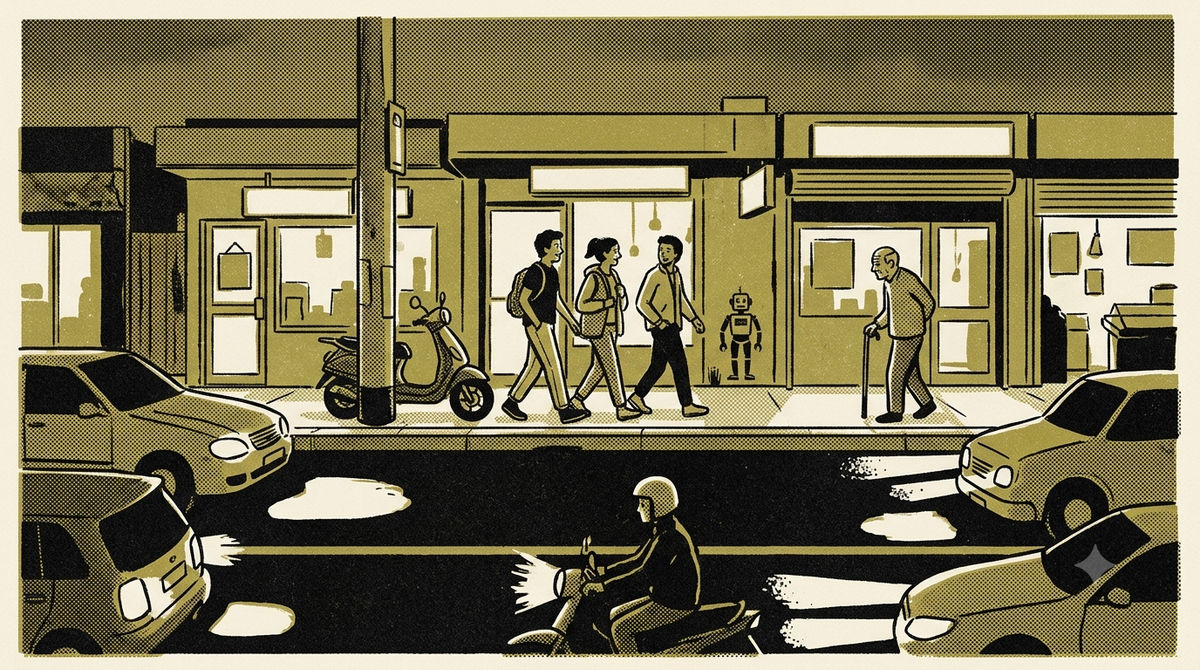
It is 7 pm on a footpath in your neighbourhood, the kind that is barely a metre wide once you count the pole and the parked scooter. You and two friends walk abreast, mid-conversation. Ahead, an older man with a walking stick comes the other way. He waits. Then he steps down off the kerb, into the traffic lane, edges around your trio, and climbs back up. None of you noticed. You were three, he was one, and the footpath decided nothing.
What's actually happening
Walking side by side is not rude. It is how people talk. The trouble starts when the path is too narrow to hold your group and still let others pass, and the group does not adjust.
Indian footpaths are unusually tight. The Indian Roads Congress guideline (IRC:103-2012) sets a minimum clear walking width of 1.8 metres, enough for two wheelchairs to pass. Most of our footpaths never reach it, and what width exists is eaten by poles, transformers, parked two-wheelers, and shop displays. So the single-file pinch point is not rare. On many streets, it is the whole street.
When a group of three holds its formation through that pinch, the cost does not vanish. It transfers to whoever is coming the other way. Often that is the person least able to absorb it: someone older, a parent with a pram, a person who cannot easily step into moving traffic.
What works better
Walk in the zipper. When the path narrows or someone approaches, the group drops to single file for a few seconds, then re-forms. It is automatic on a hill trail. It works just as well on a footpath.
A simple rule of thumb: if your group is wider than half the usable path, you are the obstruction, not the other person. The one who sees the pinch coming is the one who adjusts. Usually that is the group, because a group has more eyes than a lone walker.
Hold the same logic on staircases, metro skywalks, and trekking trails. Keep to one side, leave a passing lane, and break formation at the squeeze. You lose three seconds of standing shoulder to shoulder. You give someone their footing back.
Why it matters
Pedestrians are not a small footnote in Indian road safety. They make up over a fifth of the people killed on Indian roads each year (Ministry of Road Transport and Highways, Road Accidents in India). A large share of those deaths happen exactly here, where the footpath was unavailable and the walker was in the carriageway.
In October 2025, the Supreme Court (S. Rajaseekaran v. Union of India) called the use of footpaths a fundamental right of every citizen. A footpath you block with a three-person wall is, for those few seconds, a footpath that is not doing its one job.
Try this next time
On your next walk with friends, watch for the pinch points: a pole, a parked scooter, an oncoming pram. Be the one who says "single file" half a second early and steps back into line. Re-form once the path opens. Do it once and it stops being a decision. It becomes the way you walk.
Quick check
1. You are walking with two colleagues on a narrow footpath after lunch. A woman pushing a pram is coming towards you, and just ahead the path narrows past a transformer. What is the best move?
Select an answer.
2. On a hill-station trail, your group of four is walking abreast and a faster walker comes up behind, then waits. Why is single file the better default on narrow paths?
Select an answer.