Crowded markets: the slipstream technique
TL;DR
- A dense crowd isn't chaos. It self-organises into lanes. Your job is to join one, not fight it.
- Slipstream: follow someone moving your way at a steady pace and travel in their wake. Calmer, and faster.
- Never stop dead in the flow. Step out of the stream first, then look at the stall.
- Stop-and-go jams come from people cutting across the flow or braking suddenly. Don't be that part of the system.
Contents
The moment
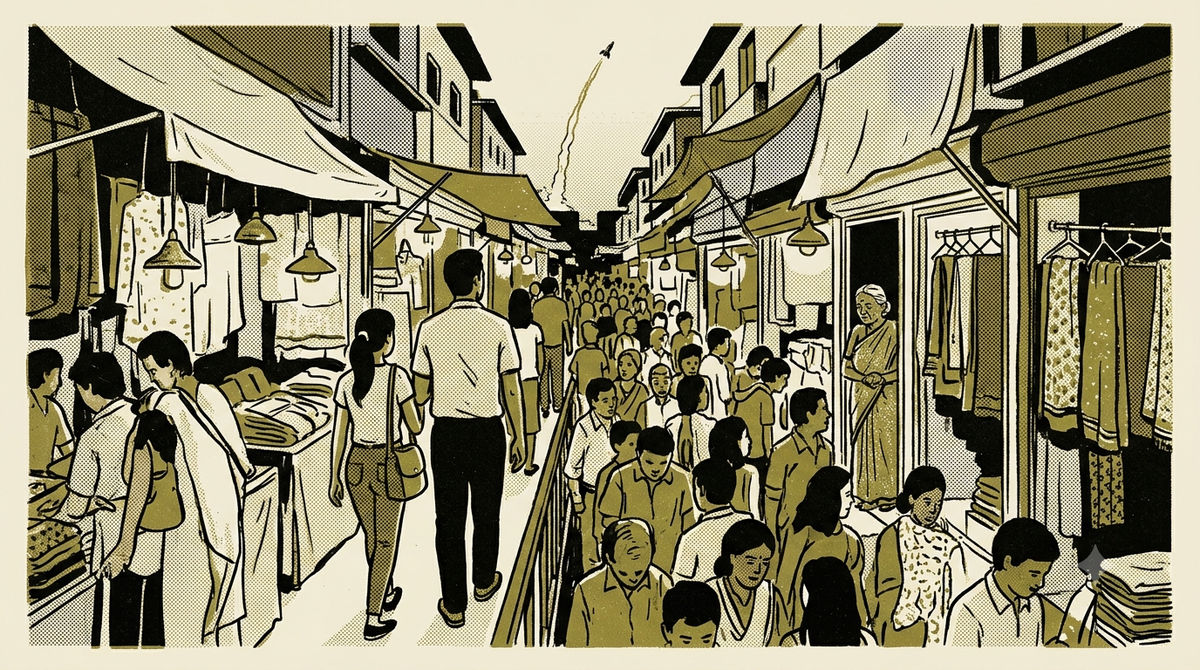
Sunday evening at a packed market lane. Shoulder to shoulder, both directions, barely moving. You spot a stall across the lane and cut diagonally toward it. Two people brake behind you. An elbow meets your bag. You stop dead to look at a shirt, and a small human traffic jam forms behind you. Ten minutes in, you have moved forty feet and irritated nine strangers.
What's actually happening
A dense crowd is not chaos. It self-organises. Researchers who study pedestrian flow find that people in two-way crowds spontaneously form lanes, each moving one direction, because following someone going your way means fewer collisions to dodge. Nobody plans these lanes. They appear on their own, the moment people stop fighting the flow.
The friction comes from the people who break the pattern. The diagonal-cutter, the sudden-stopper, the upstream-barger. Pedestrian-flow studies show the stop-and-go waves that ripple through a crowd come mostly from individuals moving faster or slower than everyone around them. One person braking hard sends a jam backward through twenty people.
What works better
Find the lane and join it. In a two-way crush, there is almost always a stream already moving your direction. Slot into it instead of carving across it.
Slipstream. Pick someone moving at a steady pace your way and follow in their wake. They part the crowd; you travel in the gap. It is calmer, faster, and you stop being the obstacle.
Do not stop dead in the flow. If a stall catches your eye, step to the side, out of the stream, then look. Stopping mid-lane is the single most common cause of a market jam.
Signal before you turn. A small shift of the shoulders, a half-second of eye contact, and people read your move and make room. Crowds run on tiny anticipations.
Carry your bag in front in a crush. It stops the bag clipping people you cannot see, and you always know where it is.
Why it matters
A crowd is a shared system, and you are one moving part in it. Flow with it and the whole lane moves faster, you included. Fight it and you slow everyone, yourself most of all.
There is a safety edge too. As density climbs, the room to recover from a stumble shrinks, and sudden cross-movements raise the risk of a fall in a packed space. At very high density this becomes genuinely dangerous, which is its own lesson (see crowd surges). The everyday market crush is not that. It is just a system that rewards people who read it.
Try this next time
In your next crowded market, pick one person moving your direction at a steady pace and slipstream them for thirty seconds instead of weaving. Notice how much less you bump into, and how much faster you move. When something catches your eye, step out of the lane before you stop. The crowd flows better, and so do you.
Quick check
1. You're deep in a packed market lane and spot a stall you want to check across the flow. What's the move that doesn't jam the crowd?
Select an answer.
2. In a dense two-way crowd, lanes of people moving the same direction tend to form on their own. Why does following one help you?
Select an answer.