COTPA: where you cannot legally smoke in India
TL;DR
- Section 4 of COTPA, 2003 prohibits smoking in nearly all public places in India.
- Public place covers offices, restaurants, transport hubs, schools, hospitals, parks, and most outdoor areas immediately adjacent.
- Fine: ₹200 on-the-spot. Some states (Karnataka, Maharashtra, Tamil Nadu) levy higher state-level fines.
- E-cigarettes and vapes are banned entirely in India. Possession alone draws up to ₹1 lakh and 1 year imprisonment.
Contents
The rule
Under Section 4 of the Cigarettes and Other Tobacco Products Act (COTPA), 2003, smoking is prohibited in all public places in India.
"Public place" includes:
- Government buildings and offices
- Educational institutions (schools, colleges, universities)
- Healthcare facilities (hospitals, clinics, nursing homes)
- Restaurants, hotels, bars, pubs (with limited exception for designated smoking areas in establishments above 30 rooms / 30 seats)
- Airports, railway stations, bus terminals
- Public transport (trains, buses, metros, taxis, autos)
- Workplaces and offices
- Cinemas, theatres, auditoriums
- Stadiums, parks, public libraries
The fine is up to ₹200, paid on the spot to authorized officers.
Why this rule exists
Secondhand smoke contains the same carcinogenic compounds as direct smoke. The WHO concludes there is no safe exposure level. The people sharing public spaces with you (children, pregnant women, asthmatics, restaurant staff, drivers) cannot consent.
India has roughly 267 million tobacco users (Global Adult Tobacco Survey, 2017). Tobacco-related illness causes about 1.35 million deaths annually here, a meaningful share among non-smokers exposed in workplaces and shared spaces.
COTPA exists to make non-smokers' lungs not depend on smokers' choices.
What happens if you don't follow it
Legally, ₹200 on-the-spot, payable to authorized officers (police, municipal staff, designated COTPA officers). Karnataka, Maharashtra, and Tamil Nadu impose higher state-level fines.
Practically, enforcement is sporadic in most Indian cities. Many smokers calculate they won't be caught, and most days they're right. That doesn't make it ethical.
Socially, smoking near non-smokers is a small daily aggression. None of these people asked you: the 18-year-old with asthma, the pregnant woman at the next table, the kid at the petrol pump. Their lungs are processing your choice.
Quick reference
Where you can smoke (legally):
- Open-air public spaces that are not parks, stations, or near a no-smoking sign
- Private homes
- Designated smoking rooms in hotels (rooms with 30+ keys), restaurants (30+ seats), and airports
- Specifically marked smoking zones in some cities
Where you cannot smoke (legally):
- All enclosed public places listed above
- Within 100 meters of an educational institution (separate offence under COTPA Section 6)
- In any workplace, including outdoor terraces of office buildings
- In any vehicle other than a private one with consenting adults only
- At ANY public bus stop, railway platform, metro station, or airport, including outdoor sections
The cigarette butt is also litter. Even in a legal smoking location, the butt belongs in a bin, never on the ground. One butt leaches toxins into soil and water for years. The Solid Waste Management Rules, 2016 fine butt-littering ₹100-₹500.
E-cigarettes and vapes are banned entirely in India under the Prohibition of Electronic Cigarettes Act, 2019. Possession, sale, manufacture, and use are all illegal. First offence: ₹1 lakh fine and up to 1 year imprisonment.
The civic move: when in doubt, step away from people and any building entrance, and check for a sign. If you see one, walk further. The 30 meters save the next person's lungs.
Quick check
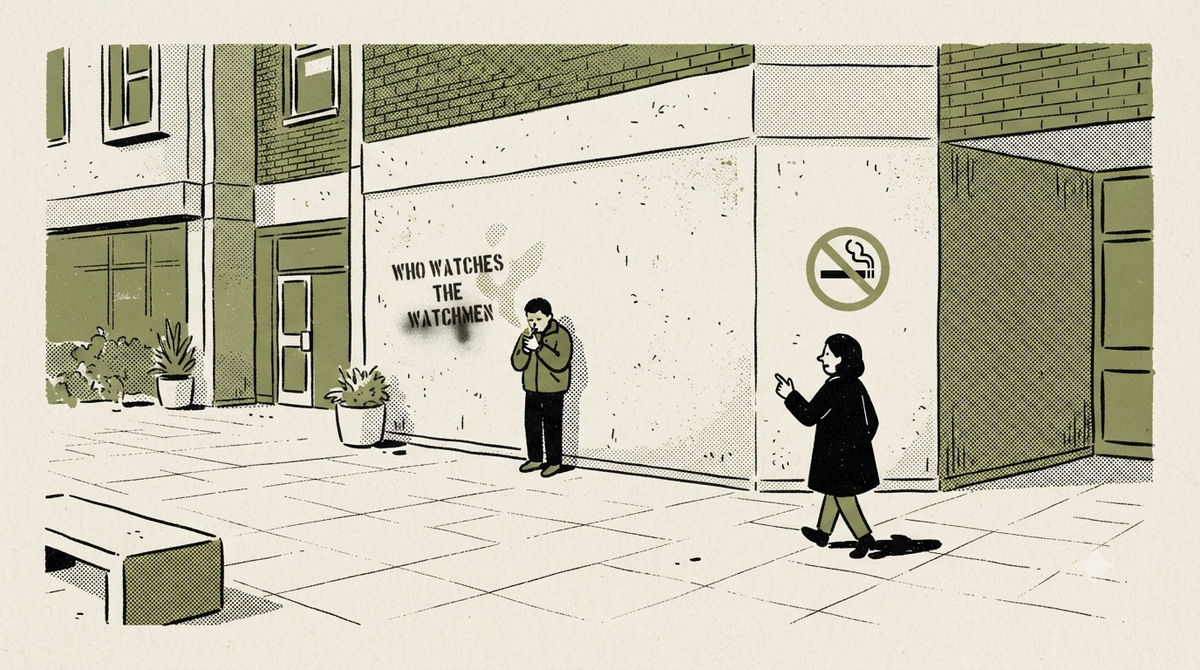
1. You're outside an office building, on the road, smoking a cigarette. A no-smoking sign is on the building wall. Are you violating COTPA?
Select an answer.