The street photographer's consent question
TL;DR
- In a public place you can usually photograph people, but 'legal' and 'consented' are not the same thing.
- If a face is the subject, treat it as a portrait and get a nod first. A gesture works in any language.
- Skip anyone in a vulnerable moment, and delete on the spot if a subject asks you to.
- Section 66E of the IT Act criminalises non-consensual images of a person's private area: up to 3 years or a 2 lakh fine.
Contents
The moment
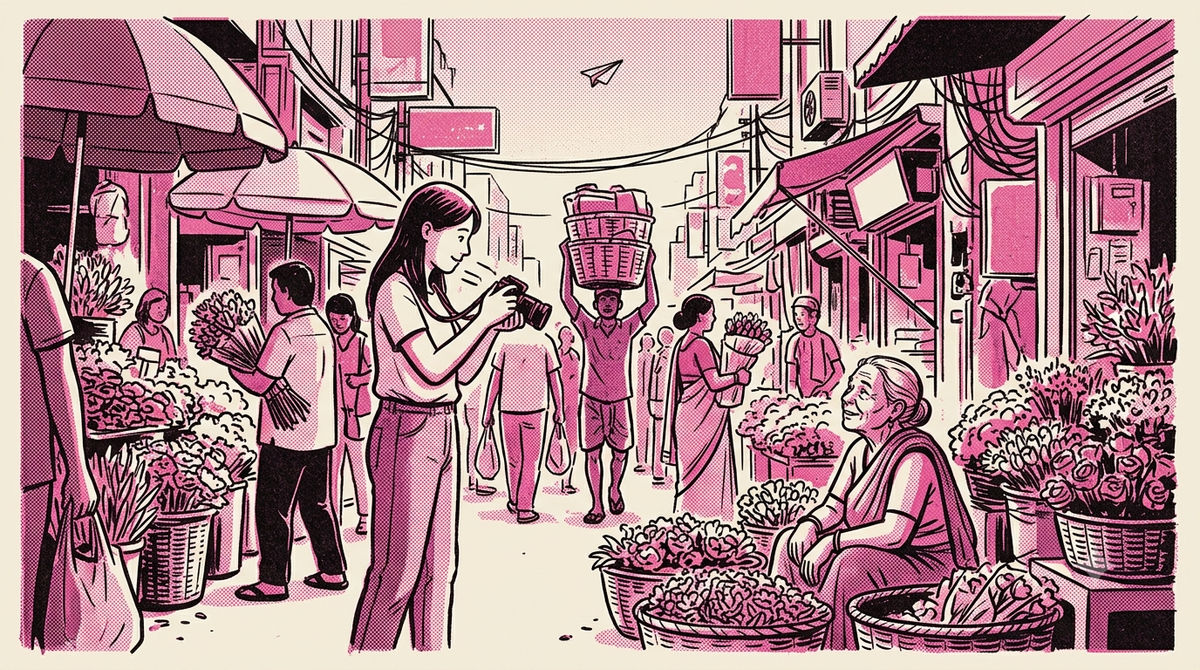
You are at a crowded flower market on a Sunday morning. An older vendor sits behind his baskets, face lined, the light falling just right. You lift your phone. He has not seen you. The frame is beautiful, the kind that gets saved and shared. Your thumb hovers over the shutter. He still does not know he is in your morning. Do you take it? Do you ask first? Does asking ruin the whole thing?
What's actually happening
The camera quietly changes the relationship. A second ago you were two strangers sharing a public lane. Now one of you is a subject and does not know it. In a public place you are, broadly, allowed to photograph. Indian law does not ban taking pictures of people on a street. But allowed and consented are not the same word. The vendor leaves with his morning intact; you leave with his face, ready to travel to a thousand phones he will never see. The belief that "candid means honest" is doing a lot of hidden work. Often it just means "I did not want to ask."
What works better
Separate two situations. If the person is the subject, an identifiable face filling the frame, treat it as a portrait and get a yes. You rarely need words. Catch their eye, lift the camera slightly, wait for a nod or a wave-off. A nod reads the same in every language. If they decline, you smile and move on; you have lost only a photo.
If people are incidental, a wide shot where no single face is the point, the bar is lower. Shoot, but stay kind. Skip anyone in a vulnerable moment: someone sleeping on a footpath, someone crying, someone whose hardship you are about to turn into your aesthetic. Never shoot to mock. If a subject asks you to delete, delete on the spot and show them.
Why it matters
Privacy is a fundamental right in India. The Supreme Court has said it includes informational privacy, your control over information about yourself (Source: Puttaswamy v Union of India). A photo of your face is exactly that kind of information. Capturing or sharing an image of a person's private body area without consent is a separate crime. It can bring up to three years in jail, or a fine up to two lakh rupees (Source: IT Act, 2000, Section 66E). Most street photos are nowhere near that line. The point is the habit below the law: once an image is posted, you no longer control where it travels.
Try this next time
Before you post a recognisable stranger, run one test: would you be fine if a stranger posted this exact photo of you, to this exact audience? If yes, and the photo is not unkind, share it. If it is a close portrait, ask first. The nod costs nothing and usually makes the picture better. Be the photographer who collects faces with permission, not the one who collects them by surprise.
Quick check
1. You are at a railway platform. A porter rests against a pillar, and the light is perfect. He has not noticed you, and you want the shot. What respects both the photo and the person?
Select an answer.
2. Which of these crosses from 'legal but discourteous' into an actual criminal offence under Indian law?
Select an answer.