The friend who appears in your story without warning
TL;DR
- Your story's audience is yours, not your friend's. A photo of them travels to hundreds of people they never chose.
- The two-second show: turn the phone around before you post. A nod settles it.
- A candid where one person is the joke needs that person's yes. A 'take it down' gets honoured at message speed.
- Stories don't really vanish in 24 hours: screenshots, the archive, and reshares all outlive the day.
Contents
The moment
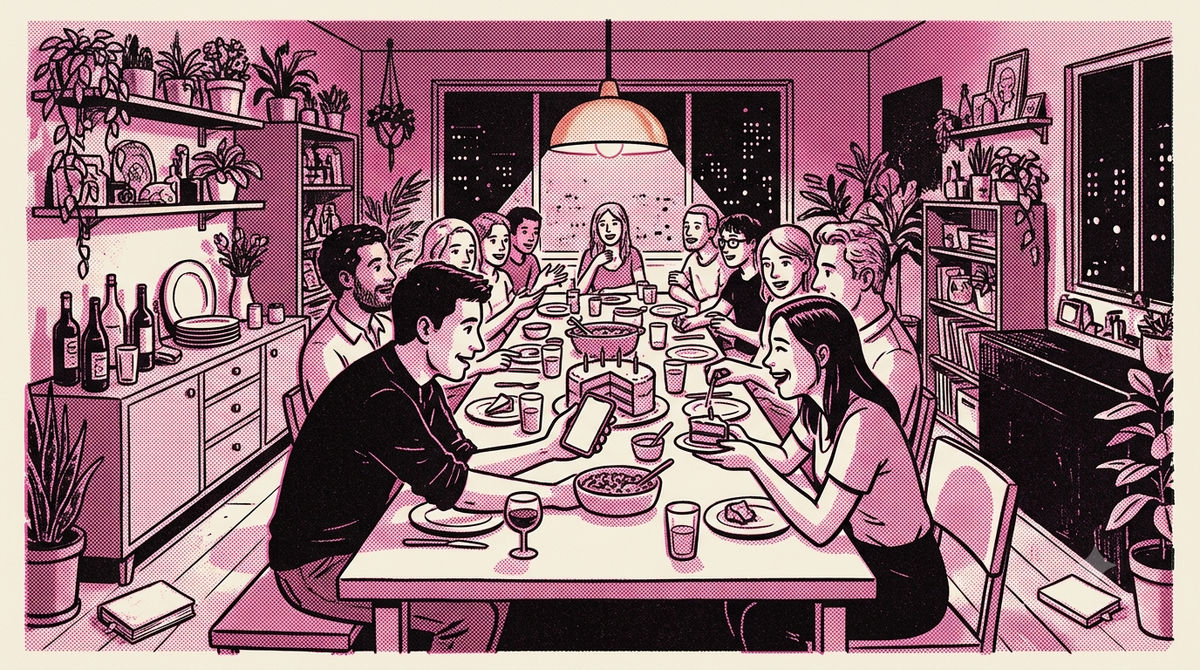
The birthday dinner is winding down. You have taken a burst of twelve photos across the table, and one is gold. Warm light, the cake mid-cut, your friend caught mid-laugh, eyes half closed, samosa in hand. You add a sticker and a caption and post it to your story before the bill arrives. At 11:40 pm your friend texts you. "A colleague I've met once just replied to YOUR story asking about me. Please take it down."
What's actually happening
You meant it as affection, and it is affection. Public posting is how this generation says "you matter to me." But look at what moved without permission. Your story reached your 340 followers. Your friend has met maybe 30 of them. The other 310 are your colleagues, your cousins, your gym group, your ex. Your friend just appeared, eyes half closed, in front of a room they never entered. "It disappears in 24 hours" is doing quiet work here too. Screenshots exist, the archive keeps a copy, and for the full 24 hours the room stays open. The photo is your memory of the night. How they look in it was never yours to assign.
What works better
Most of the time, your friend would have said yes. The point of asking is that you cannot know which time this is from your side of the table. So run the two-second show: turn the phone around before you post. "Story?" A nod settles it. At the table, this costs nothing and reads as courtesy, not paperwork.
Calibrate by photo, not by friendship. A group shot where everyone looks fine needs judgment, not a committee. A candid where one person is the joke needs that person's yes, and a no is a complete answer. You have lost only a photo.
If the ask arrives after you post, deletion is the answer. Someone says "take it down," you take it down at message speed, then confirm it is gone. Speed is the apology. Negotiating ("but you look great") converts a small repair into a real argument.
Why it matters
Control over your own image is not vanity. The Supreme Court has recognised informational privacy, your control over information about yourself, as part of the fundamental right to privacy (Source: Puttaswamy v Union of India). A recognisable photo of your friend is exactly that kind of information. Instagram itself runs a dedicated channel for reporting an image of you posted in violation of your privacy (Source: Instagram Help Center). That form exists for strangers. Between friends, a turned-around phone does the same job in two seconds, with the friendship intact.
Try this next time
At your next dinner, before you post anyone identifiable, turn the phone around and collect the nod. Count how often the answer is an easy yes; that is the full cost of asking, measured. Be the friend whose stories nobody has to monitor.
Quick check
1. Your friend fell asleep on the evening train home, head against the window, mouth open. The photo is objectively funny, and your thumb is on 'Add to story.' What works?
Select an answer.
2. Three hours after you posted a group photo, one friend messages: 'Please take that down, I hate how I look in it.' The photo already has replies. What's the move?
Select an answer.