Construction noise rules in Indian cities (and how to file the complaint)
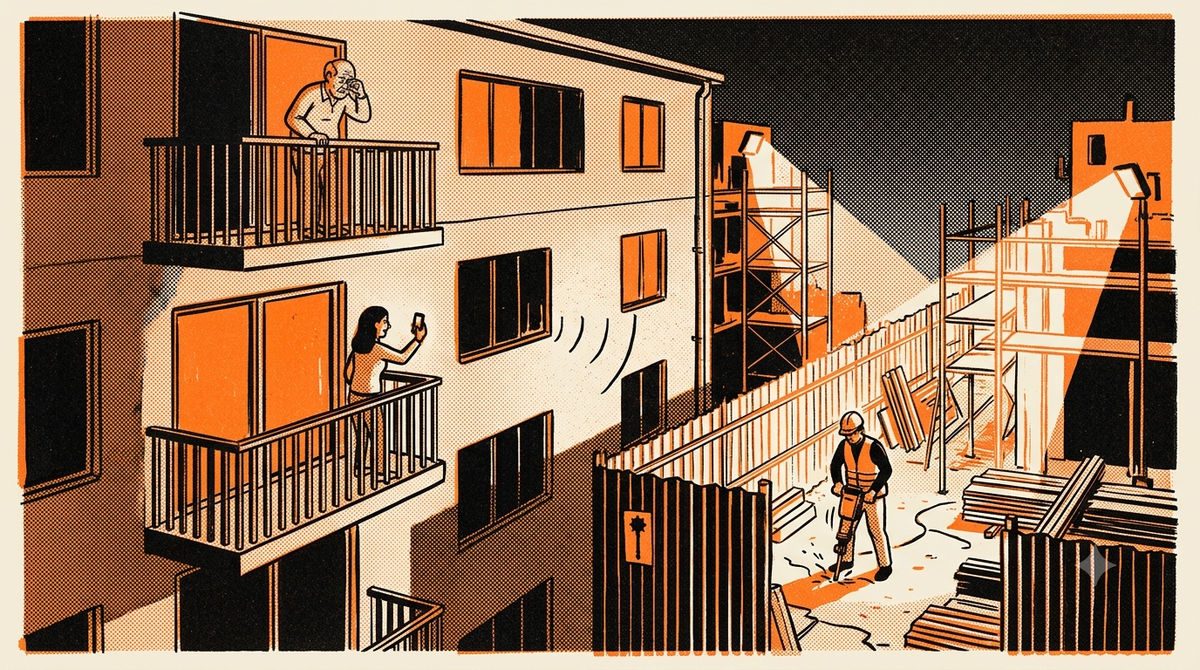
TL;DR
- Construction near homes has a legal noise ceiling: 55 dB by day, 45 dB at night in residential zones, and tighter near hospitals and schools.
- Night construction next to homes is effectively not allowed under the Noise Pollution Rules, 2000.
- If you are disturbed, complain in writing first (note the time), then your RWA, then the State Pollution Control Board or the CPCB noise grievance. After 10 pm, call 112.
- The timestamped record, not the shouting match, is what actually moves a builder.
Contents
The rule
Construction noise that crosses into a residential area is capped by the Noise Pollution (Regulation and Control) Rules, 2000. In a residential zone the ceiling is 55 dB during the day (6 am to 10 pm) and 45 dB at night (10 pm to 6 am). Near a hospital, school, or court, the silence-zone limit is stricter: 50 dB by day, 40 dB at night. Night construction next to homes is, in practice, not allowed.
Why this rule exists
The limits sit under the Environment (Protection) Act, 1986. They protect the people who cannot walk away from the sound: an infant, a night-shift nurse asleep at noon, someone recovering from surgery, an elderly neighbour. A jackhammer runs at 90 to 100 dB at the source. Every 10 dB above the limit roughly doubles how loud it feels. The rule does not ban construction. It fixes the hours and the ceiling so a city can build without stealing everyone's sleep.
What happens if you don't follow it
The system here is real, if slow. A State Pollution Control Board can order the work paused and seize the offending equipment. Under Section 15 of the Environment (Protection) Act, a violation can carry imprisonment up to five years, a fine up to one lakh rupees, or both. Most cases never reach that. What a complaint reliably does is create a dated record, and the record is what moves a builder who ignored a polite request.
Quick reference
If you are running the construction: keep the noisy work inside daytime hours, tell neighbours the rough schedule, and pick the quieter tool where one exists.
If you are the disturbed neighbour, escalate in order:
- Ask the site supervisor or builder in writing (a WhatsApp counts). Note the date and time.
- Raise it with your RWA or the builder's office.
- File with your State Pollution Control Board, or the CPCB online noise grievance, which routes to your city's board. Attach a phone decibel-meter reading and a short clip.
- For work after 10 pm, call 112 for immediate response, then file the written complaint.
Keep every timestamp. The record is the lever.
Quick check
1. Your neighbour's flat renovation has drills and hammering going strong at 11:15 pm on a weeknight. You have work tomorrow. What is the most effective first move?
Select an answer.
2. Daytime construction is legal, so what actually sets the ceiling on how loud a residential-area site may be during the day?
Select an answer.