The 11 pm wind-down: the unspoken urban contract
TL;DR
- The 11 pm wind-down is an unwritten rule in most Indian housing societies, and the legal night limit (45 dB) backs it up.
- One pre-emptive WhatsApp to neighbors before a late party buys most of the goodwill you need.
- Drop the music at 11 pm even if the party continues. Conversation carries the rest.
- If you are the disturbed neighbor, ask calmly first. Escalate to the RWA or police only if the polite ask fails.
Contents
The moment
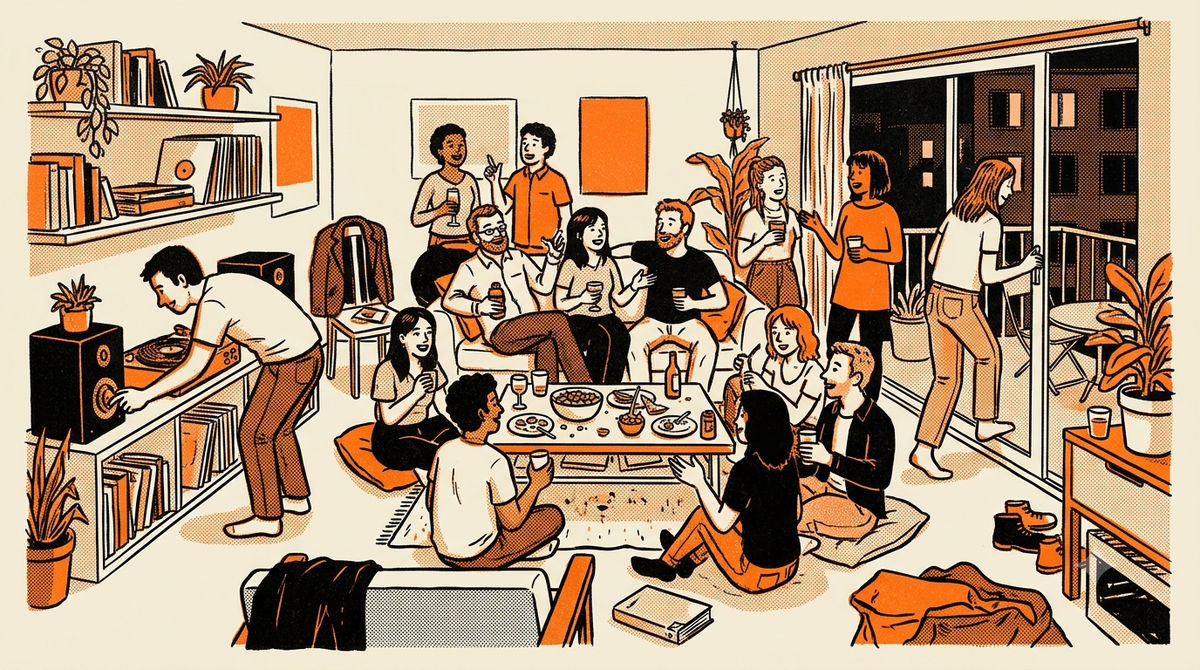
It is a Friday night in your housing society in Whitefield. Your sister's surprise birthday is at your apartment. Fourteen friends, two speakers, a Spotify queue running to House Party Hits, mocktails on the kitchen counter. The party started at 8:30 pm. It is now 10:55 pm. The neighbors above you have a 7-year-old who has school tomorrow. The aunty next door is sleeping. The night guard came up at 10:15 pm to ask you to lower the volume. He came back at 10:40 pm. Your sister wants to keep going till midnight. You are hosting.
What's actually happening
The 11 pm wind-down is one of the most universal Indian urban norms that nobody explicitly teaches. Most housing societies have an unwritten rule: noise that travels beyond your walls should drop at or before 11 pm. The contract is bilateral. You get to celebrate till 11. The neighbor gets to sleep after.
The legal layer is more specific. The Noise Pollution Rules, 2000 set residential limits at 55 dB during the day (6 am to 10 pm) and 45 dB at night (10 pm to 6 am). That includes amplified sound from inside an apartment if audible at the neighbor's wall. The night drop of 10 dB is roughly a 50 percent cut in perceived loudness.
Loudspeaker use after 10 pm is restricted in most states. Wedding and event permits stretch this to midnight. Enforcement is patchy. The civic upgrade is voluntary.
What works better
For house parties, the wind-down protocol:
8 pm to 10 pm. Moderate volume. Doors can stay ajar.
10 pm to 11 pm. Music drops one notch. Conversations move inside. Outside-facing windows close if music continues. Loud games wind down.
11 pm onward. Background music or none. Speaking voice, no shouting. The party becomes a low-key hangout.
If you genuinely need to keep things going past 11 (a milestone occasion):
Send a pre-emptive WhatsApp. A line in the building group 24 hours ahead: "Having Sneha's 30th tonight, expect music till about midnight. Apologies for the disruption. Will keep it as low as we can after 11." This single act buys 70 percent of the goodwill. The neighbor who got the notice makes peace with it. The one who did not escalates.
Cap the music at 11 even if the party continues. People at parties do not need music after 11. The conversations carry the energy.
Why it matters
Indian apartment walls transmit sound well. Your party in 4B is also your neighbors' party in 3B, 5B, 4A, and 4C, without their consent.
The legal limits are real. Sustained noise above 45 dB at the neighbor's wall after 10 pm is a violation under Section 5 of the Noise Rules, 2000. RWAs can act. Police can be called. Most cities have a noise helpline that works some of the time.
The civic argument is independent of enforcement. The neighbor with the 7-year-old, the night-shift worker, the parent with a colicky baby. They exist. They need sleep.
Try this next time
Hosting a late one? Send the WhatsApp 24 hours in advance.
Attending one running loud past 11? Suggest moving inside or wrapping. The host may not notice the time.
Being the disturbed neighbor? Calm WhatsApp first ("hey, the music is carrying, could you bring it down?"). Banging on the door comes later, not first. Most hosts will respond. If the disturbance becomes a pattern, escalate to the RWA or municipal noise complaint number.
Quick check
1. It's 11:35 pm on Saturday. Your neighbor is hosting a wedding pre-function with music at high volume that you can clearly hear in your bedroom. You haven't had any prior intimation. What's the move?
Select an answer.