Long-haul: hydration, movement, and the seatmate truce
TL;DR
- Sitting still for hours in dry cabin air is the real long-haul risk. The WHO found clot risk roughly doubles on flights over four hours.
- Hydrate on a schedule, not on thirst, and go easy on alcohol and coffee, which dry you out further.
- Move once an hour: a short aisle walk, or ankle circles and calf raises in your seat.
- Set the seatmate truce early. Tell your row you'll be up a few times, and let others past without a sigh.
Contents
The moment
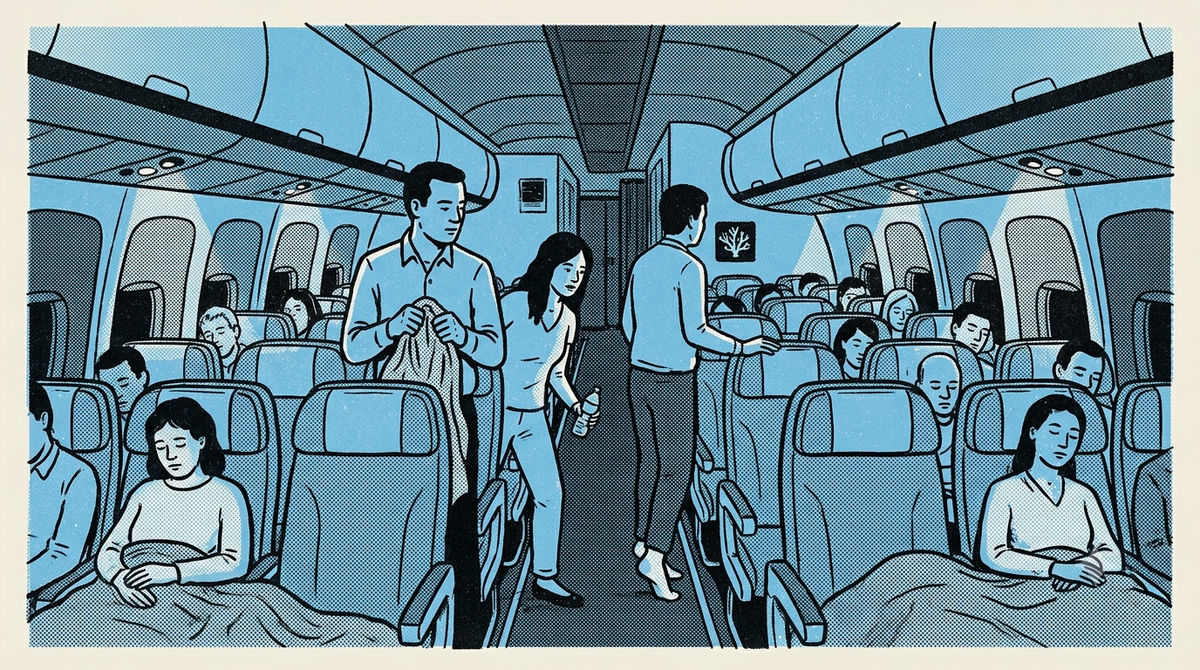
It is hour nine of a fourteen-hour flight to Toronto. The cabin lights are off. You are in the window seat, your legs have gone stiff, your mouth is dry from three cups of airline coffee, and you badly need the toilet. But the two people in your row are asleep, and waking them feels worse than holding it. So you sit still, dehydrated and cramping, quietly calculating how long you can last.
What's actually happening
Two problems are stacking up, and both are avoidable. The first is your body. Sitting still for hours in dry cabin air thickens your blood and stiffens your legs. The World Health Organization found that the risk of a blood clot, deep vein thrombosis, roughly doubles on flights over four hours (Source: WHO). The absolute risk stays low, about 1 in 6000 for a healthy traveller, and the fix is nearly free: water and movement (Source: WHO).
The second problem is social. You and your seatmates are all running the same silent calculation, because nobody wants to be the one who disturbs the row. So everyone under-hydrates and over-holds, and the aisle seat guards its armrest like a border post. The truce that would help everyone never gets opened, because nobody says the first line.
What works better
Hydrate on a schedule, not on thirst. Carry an empty bottle through security, fill it after, and aim for a cup of water every couple of hours. Go easy on alcohol and coffee, which dry you out further (Source: NaTHNaC). Yes, this means more toilet trips. That is the goal, not the cost.
Move before you stiffen. Once an hour, do a lap of the aisle, or ankle circles and calf raises in your seat if the cart is out. Fold the toilet trip and the leg-stretch into one.
Set the seatmate truce early. When you sit down, say it plainly: "I drink a lot of water on flights, so I will be up a few times. Just wave me past whenever." That puts the deal on the table upfront. If you have the aisle, the generous move is to rise smoothly when asked, not to make someone climb over you. On a fourteen-hour flight, each of you will need out. The small courtesy you extend now buys you the same when it is your turn.
Why it matters
A long-haul cabin is a shared room where everyone is tired and no one is at their best. The person who hydrates, moves, and lets others past is not just healthier, they lower the tension for the whole row. Multiply one considerate row across a wide-body and the flight is a calmer place to sit for fourteen hours.
Try this next time
On your next long flight, do one thing at the start: tell your row you will be up a few times, and mean it. Then set a mental reminder for once an hour, water and a stretch. You will land less swollen, less stiff, and on better terms with three strangers you will never see again.
Quick check
1. It's hour ten of a long-haul flight. You've barely moved and your legs feel stiff. Your seatmates are asleep. What's the move backed by the health research?
Select an answer.
2. You're in the window seat and thirsty, but you've stopped drinking so you won't have to wake the two sleeping passengers beside you. Better approach?
Select an answer.