The unwritten rules of water parks
TL;DR
- On any slide of two metres or more, the board at the top carries five required lines. Read them, because they change from slide to slide.
- Clear the splashdown pool at once. Under the standard, your exit path must not cut across the path of riders from other slides.
- Swimwear, not a T-shirt. India's water park standard says so in plain words.
- Do not swim, or let a child swim, while sick with diarrhoea. Do not swallow the water.
Contents
The moment
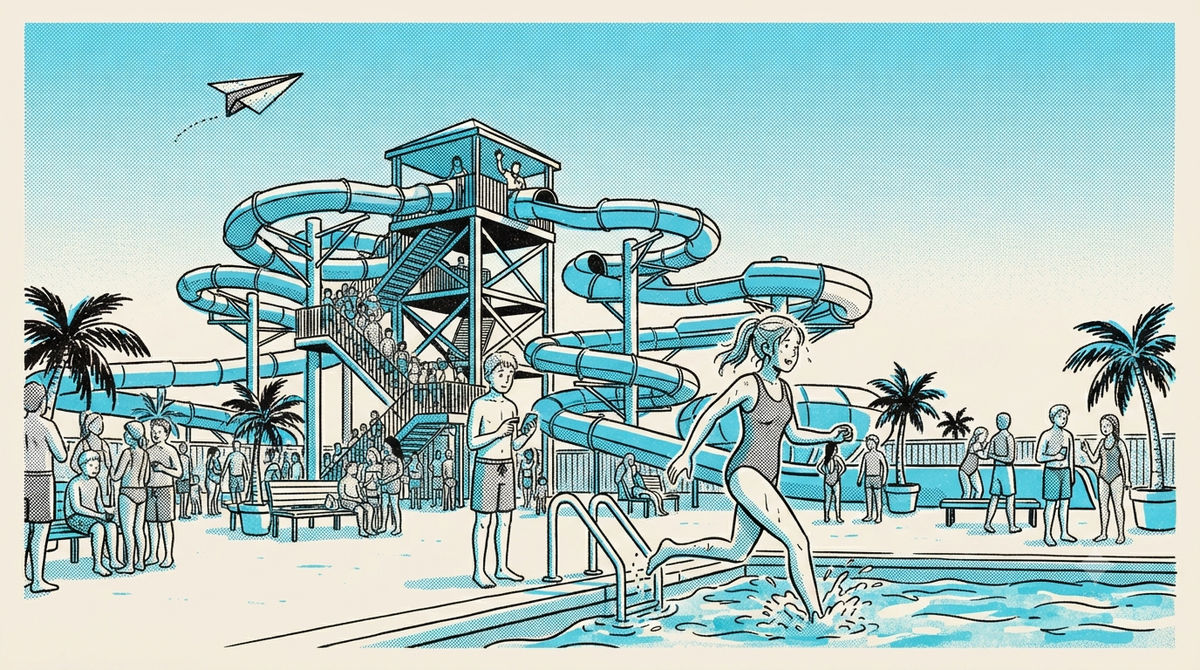
A water park an hour out of the city, a Sunday, twenty to twelve. Forty minutes of queue behind you, and now you are at the top of the tallest slide. The man ahead passes his phone back for a video and asks the attendant to hold. Below, in the splashdown pool, a family of four stands waist-deep in the run-out, arranging themselves for a photograph. The attendant blows his whistle twice. Nobody looks up.
What's actually happening
Water park rules read as invented. No cotton clothes. One at a time. Feet first, arms crossed. Leave the pool at once. Nobody explains any of it, half the signage is about the management not being responsible, and the person enforcing it is nineteen with a whistle. So the rules land as fussiness rather than instruction.
They are not invented. There is an Indian Standard, IS 15492, in three parts, the Code of Recommended Practice for Safety in Water Parks. The Bureau of Indian Standards wrote it in 2004 because the Punjab and Haryana High Court asked it to, after incidents at water parks that cost lives.
Part 3 covers slides of two metres and up, and it fixes what the board at the top must carry. Type of slide. Minimum age. Water depth in the splashdown area. How to exit quickly after the ride. The recommended safe sliding position. Five lines, and most people go down having read none of them.
What works better
Read the board. Ten seconds, and it changes from slide to slide.
Get out of the splashdown pool at once. Part 2 is flat about it: your exit path must not interfere with the path of riders from other slides. Where several slides land on the same side, it puts the exit across the water to push you forward. Standing in the run-out for a photograph puts you inside a design assumption.
Swimwear, not a T-shirt. Part 1 says no one may enter the water in any apparel other than a recognised swimming costume or trunks. A soaked T-shirt is also drag you did not plan for at speed, and cotton is not kind to a filtration system.
Children under 12 go in with an adult, and Part 1 puts the responsibility for their conduct and safety on that adult. A lifeguard on the deck does not take it off you.
Nothing in your hands, nothing in your pockets. Phones included.
Why it matters
The part that spreads is the part you cannot see. US health authorities logged 208 outbreaks tied to treated recreational water between 2015 and 2019. Cryptosporidium, a parasite chlorine does not kill quickly, caused 76 of them and 2,492 of the cases. The largest single outbreak in that set reached 638 people.
Those are American numbers, because that is where the surveillance is run. Read them as the shape of the risk, not as an Indian count. A water park is the version that scales: one circulation system, thousands of bodies, a peak season.
The two instructions that report closes on are short. Do not swim, or let your child swim, while sick with diarrhoea. Do not swallow the water.
Try this next time
At the top of each new slide, read the five lines before you sit. At the bottom, clear the pool first and take the photograph from the edge. Then look back and time how long the next rider takes to arrive.
That gap is your margin. Be the rare person in the queue who has actually read the board.
Quick check
1. You have just come down a slide into the splashdown pool. Your cousin at the edge is holding up a phone and waving at you to pose. What is the correct order of operations?
Select an answer.
2. It is a hot day and you would rather not be in swimwear in a crowded park, so you plan to go down the slides in a cotton T-shirt and shorts. How does that land?
Select an answer.
Sources
- IS 15492 (Part 1): 2004, Code of Recommended Practice for Safety in Water Parks, Part 1: General Information
- IS 15492 (Part 3): 2004, Code of Recommended Practice for Safety in Water Parks, Part 3: Instructions
- IS 15492 (Part 2): 2004, Code of Recommended Practice for Safety in Water Parks, Part 2: Safety Requirements
- Outbreaks Associated with Treated Recreational Water, United States, 2015-2019