The cannonball question: when, where, and probably never
TL;DR
- Cannonballs and high-energy moves are fine when the pool is empty or zoned for them.
- In a shared pool with lap swimmers, lessons, or families, match the energy level of the room.
- Scan before any big move: laps in progress? Lessons? People at the edge? If yes, switch.
- Save the cannonball for the 6 am empty pool or the water park.
Contents
The moment
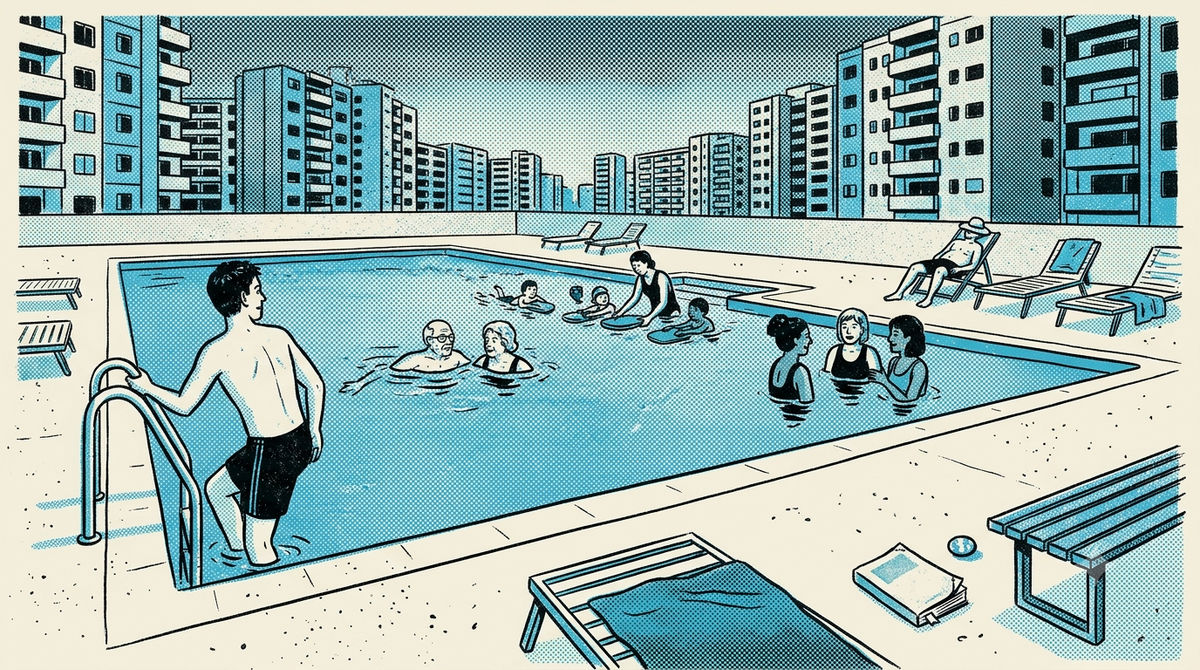
The pool at your friend's society in Hiranandani is half full on a Sunday afternoon. An older couple is doing slow laps in the corner. Three women in their 40s are chatting waist-deep at the shallow end. A man is swimming with his 6-year-old daughter, her arms around his neck, both serious about their lesson. At the deep end, your cousin Aakash, age 22, climbs out, runs four steps, and launches himself into a cannonball. The slap of impact echoes off the building. A wave of water hits the woman doing breaststroke. The 6-year-old's lesson is interrupted by the wash. Aakash surfaces grinning. The woman exits the pool to dry her face. Nobody says anything. Nobody ever says anything.
What's actually happening
Aakash is not a bad person. He's having a good time. The problem is that "having a good time" in a shared pool is a bandwidth question, and Aakash just used everyone else's bandwidth.
The pool is a slow space. People doing laps need predictable water. People teaching their kids need calm conditions. People chatting are doing the social-pool thing. The cannonball, the dive, the shoulder-tackle race: these are high-energy moves that absorb the calm of the pool and convert it into someone else's frustration.
A shared pool is not your private bath or your action sports park. It's a space with mixed uses, and your fun has to fit alongside everyone else's without conquering it.
Nobody taught us pool etiquette because we never had pool culture to begin with. The fix is simple enough.
What works better
Cannonballs, dives, races, and high-energy water games are appropriate when:
The pool is mostly empty (you, your friends, no other groups present). Or, the pool has a designated deep-end or dive zone separated from the swim area. Or, the pool is at a water park where the implicit social contract includes splash.
Cannonballs are not appropriate when:
People are doing laps. Children are taking lessons. Anyone is reading or sitting at the pool's edge. There's a "no diving" sign (most Indian society pools post these because the deep end is rarely deep enough for safe diving).
If you want energy: short freestyle sprints in your lane, underwater swimming, or water polo passing if you have the space. Swim laps. None of these bother anyone.
For kids: use the separate kiddie pool when available, or supervised splash games at the shallow end away from lap swimmers. The 5-year-old at the swim lesson is also a kid.
Why it matters
Society pools are often the only swim option for thousands of residents in Indian cities. Using them as personal action zones shuts people out. The older swimmer doing laps. The parent teaching their child. The woman who comes only when the pool is not aggressively male.
Pool-use complaints in residential societies consistently flag behavior as the top issue, above water quality. Uncontrolled high-energy use is repeatedly cited as a primary conflict driver in shared recreational water spaces.
Try this next time
Before any high-energy move, scan the pool. Are there laps in progress? Lessons? People sitting at the edge? If yes to any, switch the move. Save the cannonball for the empty 6 am pool, the water park, or the day you have the place to yourself.
Quick check
1. It's Sunday at 4 pm at your society pool. There are 8 people in: 2 doing laps, 4 chatting waist-deep, a parent teaching a 7-year-old, and a man reading a book at the edge. You arrived to swim with your two friends. What's the right setup?
Select an answer.