Lap lanes, and why splashing in them is hostile
TL;DR
- Lap swimming is the one thing in a pool that cannot be paused and picked up again.
- Take the empty lane. Standing and talking in an occupied one is the actual problem, not the splash.
- Sharing a lane with one swimmer: wait at the wall, ask to split it, let them pick a side.
- Three or more in a lane: circle swim, keep right, rest in the corner and never in the middle of the wall.
Contents
The moment
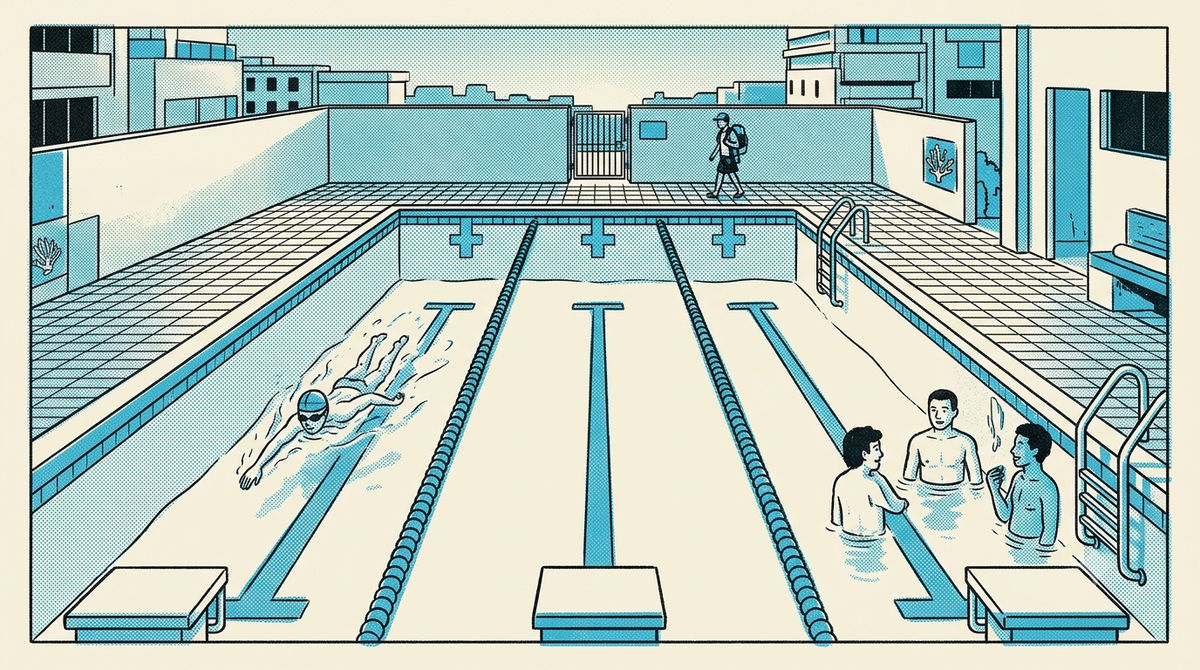
It is 6:40 am at the society pool. Two lane ropes, three lanes, one lifeguard just unlocking the gate. In the far lane a swimmer in a cap and goggles is twenty minutes into a long swim, turning at each wall without breaking rhythm.
You arrive with two friends. The middle lane is empty, but the steps are in that lane, and the steps are where everyone gets in. So the three of you get in there and stand chest-deep, talking. The swimmer reaches the wall, waits, goes around you, keeps going. On the next length somebody's arm sends a wave across their face exactly as they turn to breathe. They swallow it, stop, cough, reset, start again. Nobody says anything. Nobody ever does.
What's actually happening
You have not done anything aggressive. You are standing in water. That is the whole point of a pool.
But lap swimming is the one thing in a pool that cannot be paused. Everything else survives an interruption. A float, a chat, a lesson: stop them and they resume where they were. A swim set is a rhythm made of stroke, turn, breath, and a fixed number of lengths. Break the breath and the swimmer inhales water instead of air. Break the turn and they lose the wall.
Say they are doing forty lengths before work. If four get interrupted, that is ten percent of a session somebody got up at half past five for. The splash is not what stings. The lane is.
None of this is obvious. Most of us learned to swim in pools with no lane ropes and nobody to explain them. The rules exist; they just never reached us.
What works better
Take the empty lane. That is the whole lesson in three words. If the steps sit in someone else's lane, get in and clear their water within seconds.
Sharing a lane with one swimmer: wait until they stop at your end and ask to split it. Let them pick a side, then hold your half.
Three or more: circle swim. Everyone goes counter-clockwise down the right-hand side of the lane. Angle in towards the centre to turn, so you push off already on the correct side.
Passing: in most pools a light tap on the foot is the accepted signal that somebody wants to go by. The swimmer ahead finishes the length, stops at the wall on the right, and lets them push off first.
Resting: stand in the corner of the lane against the rope, never in the middle of the wall. The middle is where people turn.
Why it matters
A lane rope says out loud what the rest of a pool leaves unsaid: this strip of water is in continuous use. WHO's pool guidance is not about lanes, but its frame applies: safety comes from design, management and user behaviour together. The rope is the design half. You are the other half.
And there is a quieter cost. The 6 am lap hour is often the only slot that works for someone with a full day ahead. Make it unusable and you have not shortened a swim, you have ended a habit.
Try this next time
Ten seconds at the poolside before you get in. Count the lanes, find the one with nobody swimming lengths, enter there. If every lane has a lap swimmer, wait at the wall and ask to split. Be the rare person who scans first.
Quick check
1. You reach the pool at 7 am. Lane 1 has one swimmer doing steady lengths, lane 2 is empty, lane 3 has two swimmers already circling. You want to swim thirty lengths at a moderate pace. Where do you go?
Select an answer.
2. You're sharing a lane and you're the slower swimmer. You reach the wall, need forty seconds to catch your breath, and the faster swimmer is halfway back towards you. What do you do?
Select an answer.