Hotel check-in in Europe: passport, tourist tax, breakfast
TL;DR
- The passport at check-in is not the hotel being nosy. Schengen rules make accommodation managers take a signed registration form and check a valid ID.
- City tax is a separate local charge. Paris sets it per person and per night, and it is usually missing from the total you paid at booking.
- Do the multiplication before you go. Where the rate is per person per night, two adults over six nights is twelve chargeable nights, not six.
- Two questions at the desk cover it: what the city tax comes to, and whether breakfast is in your rate.
Contents
The moment
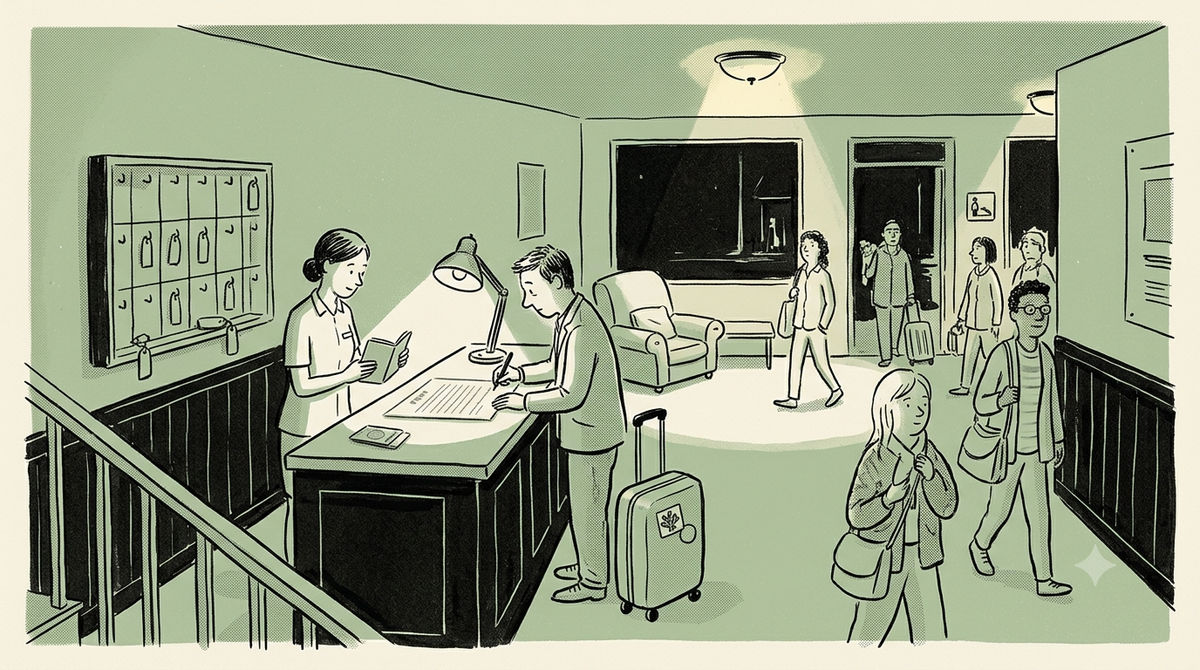
Half past nine at night in Lisbon. Your flight lost two hours over Frankfurt and you want a bed. The person at the desk asks for your passport, types a while, then slides a form across to sign. Then comes a city tax. Four nights, two adults, payable now. You paid for this room in full six weeks ago.
What's actually happening
Two different systems have met at the same desk, and neither of them is the hotel's idea.
The passport is a registration duty. Article 45 of the Schengen Convention puts the obligation on the states that signed it. Accommodation managers must see that foreign guests personally complete and sign a registration form, and confirm who they are with a valid identity document. Germany's version, on the federal government's own service portal, is precise. You sign on the day you arrive. Staff compare the form against your passport and note any mismatch. In a tour group of more than ten, only the guide signs. The form is kept for a year, then destroyed within three months of that.
So nobody is being suspicious of you. This is paperwork with a clock on it.
The city tax is separate, and usually set locally. No two cities quote it the same way. Paris publishes its mechanics plainly. Every adult in paid accommodation who is not a resident of the commune owes it. Minors are exempt. The rate is set per person and per night. The hotel or the platform collects it and passes it to the city each quarter. The rate that applies is the one in force during your stay, not when you booked.
What works better
Take the passport itself to the desk. The rule asks you to present a valid document in person, and staff to compare it against your form. A phone photo does not do that job.
Ask for the tax figure at check-in. "What does the city tax come to, and when do you charge it." Two seconds, no surprise later.
Do the multiplication before you book. Where the rate is per person and per night, as in Paris, two adults across six nights is twelve chargeable nights. Where children are exempt, they may not count.
Do not argue the tax at the desk. The receptionist cannot waive it. They are collecting money they must pass on.
Settle breakfast in the same breath. Ask whether it sits inside your rate and what time it runs. Many properties sell the same room both ways, and booking sites are not loud about which you took.
Why it matters
You have met a version of this already, at any Indian hotel where the desk photographs an ID before releasing the key. What is different is that you sign it yourself, and each country runs its own retention clock. Reading it as suspicion buys you a sour first ninety seconds and nothing else.
The tax is the half that costs money. Charged per head, it scales with your group size and your trip length. It is also the line most likely to be missing from the total you screenshotted at booking.
Try this next time
Before your next European booking, search the city's name with "tourist tax" and open the official municipal page, not a travel blog. Note how the rate is set, multiply by adults and nights, and put that number in your budget. Then pack the passport where you can reach it at the desk, not at the bottom of a bag late at night.
Quick check
1. You check into a hotel in Munich. The receptionist asks for your passport, then hands you a form to sign yourself rather than filling it in for you. Your colleague says this is an overcautious hotel. What is actually going on?
Select an answer.
2. Checking out of a Paris hotel, you find a city tax on the bill that was not in the total you paid online. You are two adults and a nine-year-old, four nights. What is the correct read?
Select an answer.