Cycling lanes are not sidewalks: the Amsterdam reality
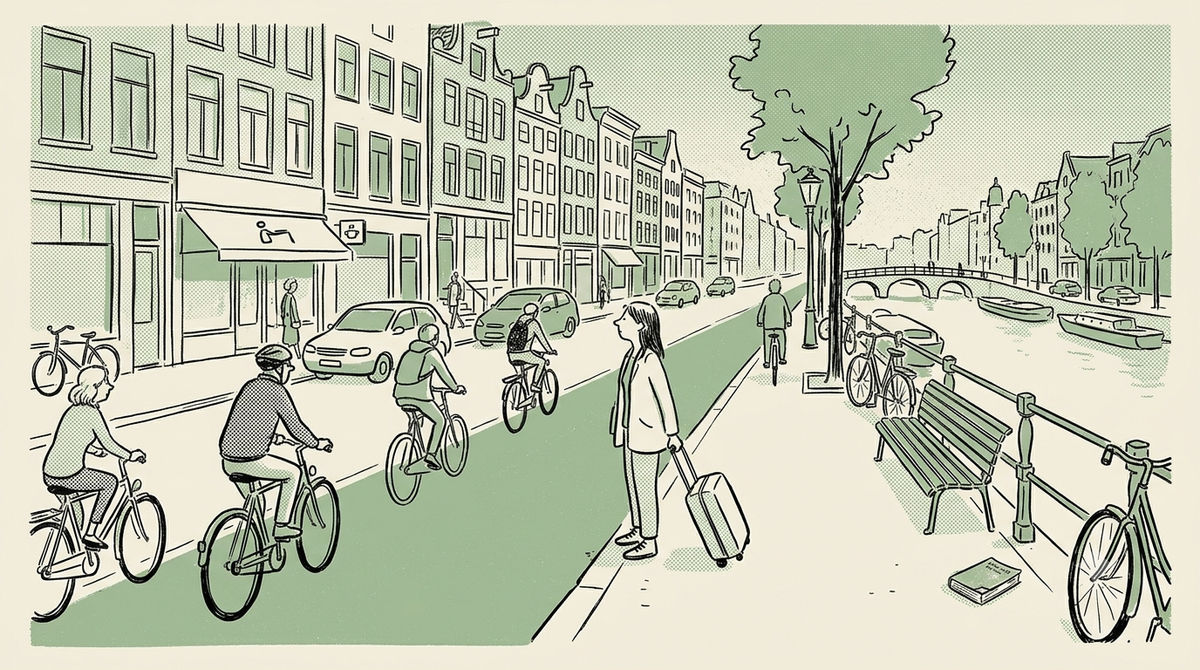
TL;DR
- The strip beside the pavement is a road, not a wide footpath. Dutch traffic law gives it to riders and gives you the pavement.
- Article 4 of the RVV 1990 is a hierarchy, not a suggestion. Pavement first, cycle path only when there is no pavement, carriageway edge only when there is neither.
- You do not have to be hit to cause harm. Almost a third of fatal cyclist crashes in the Netherlands involve no collision with anyone at all.
- Cross the strip at right angles, look both ways, and do your standing and photographing on the pavement.
Contents
The rule
The strip beside the pavement is a road with one assigned user, and that user is not you on foot. Walk on the pavement, cross the strip at right angles, and stand still only on the kerb side.
Why this rule exists
Dutch law states the order plainly. Article 4 of the RVV 1990 says pedestrians use the pavement or the footpath. They use the cycle path only if pavement and footpath are absent. They use the verge or the far edge of the carriageway only if there is no cycle path either.
That is a hierarchy, not a courtesy. Article 5 puts the mirror duty on riders: cyclists use the mandatory cycle path, and take the carriageway only when there is none. Nobody in the system is choosing a surface. Everybody has been assigned one.
The stakes sit in the national numbers. In 2025, 759 people died on Dutch roads. Cyclists were the largest group at 281, ahead of car occupants at 228, and 63 percent of those cyclists died of head injury. Across 2021 to 2025, 31 percent of fatal cyclist crashes involved no collision with another road user or a fixed object at all. The rider simply went down.
That last figure is the one to carry. You do not have to be touched, or to touch anyone, for a fall to happen.
What happens if you don't follow it
Immediate. A bell behind you, close. The rider is at commuting speed and planned a line through an empty lane. A bell is information, not a negotiation.
Physical. A swerve at that speed puts the rider on the ground. You will not have felt a thing.
Legal. In that moment you are the one in the wrong place, and the regulation is specific about it.
Honest about the habit. Walking wherever there is room is what an Indian street teaches, because the footpath is often missing, parked on, or hawked from. That is a rational response to real infrastructure. It is also a habit that stops working the moment the lane exists and is full.
Quick reference
- Read the surface before you step. A separate strip, usually a different colour, often with its own small signals and signs.
- Cross it, do not walk along it. Look both ways first, because many cycle paths run in both directions.
- Photographs, maps and goodbyes happen on the pavement.
- Stepping off a tram or out of a car door, check the strip before your foot lands.
- Keep children and wheeled luggage on the side away from the lane.
- If you rent a bike, the same rule points the other way. The mandatory cycle path is yours and the pavement is not.
- People moving with the help of objects that are not vehicles are the deliberate exception in Article 4.
- Treat the bell as the whole warning. Move first and look afterwards.
Quick check
1. You are walking along a canal in Amsterdam. There is a pavement, and beside it a smooth strip of a different colour that is emptier and easier to walk on. Your friend steps onto it. What does Dutch law actually say?
Select an answer.
2. A friend argues that stepping into a cycle lane is harmless because a bicycle is slow and light, so the worst case is a bit of shouting. What do the Dutch numbers say?
Select an answer.