The wall behind your office: it's also somebody's wall
TL;DR
- India has a real public toilet shortage. The civic move is to acknowledge that honestly, then look at the agency the urban reader still has.
- The wall is somebody's. The shop owner's, the school boundary, the home behind it. 'Easiest option' externalises the cost to people who never agreed to host it.
- For your regular routes, map the nearest two public toilets each. Petrol pumps, metro stations, hotel lobbies, malls. Ten minutes of one-time research saves a thousand uncomfortable moments.
- If you've urinated publicly recently, file one municipal request for a new public toilet at the location where you felt the absence. SBM Urban funds these. The request takes four minutes.
Contents
The moment
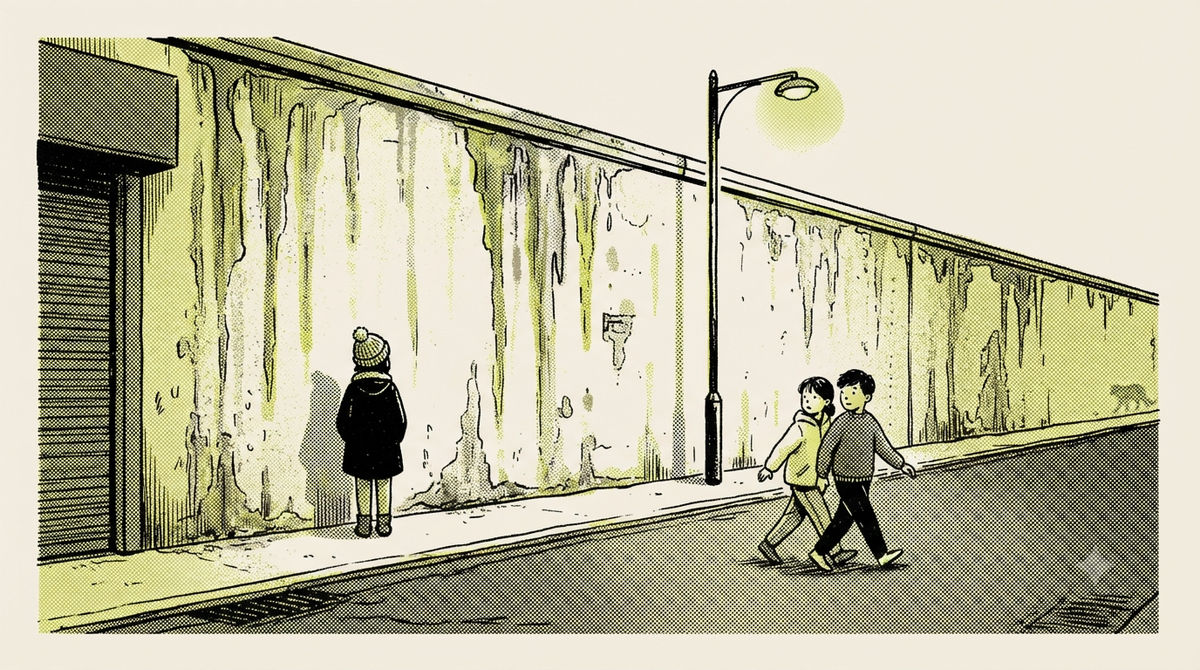
It is 6:45 pm on a Tuesday. You are walking home from your office in Sector 18, Noida. You pass a wall, the side of a closed showroom. A man stands 30 cm from the wall, doing what people do when there is no toilet for 800 metres in any direction. Two others have done it before him in the half hour since the auto stand emptied out. The wall has long brown vertical streaks. The ammonia is established. You do not want to look. You also do not want to judge. You walk faster.
What's actually happening
This is the most uncomfortable lesson on the platform to write, because two real things sit on top of each other.
The first: India does not have enough public toilets. The Swachh Bharat Mission Urban dashboard shows construction has grown sharply over the last decade. Coverage still lags CPHEEO's working ratios in most large cities. For an auto driver, a delivery worker, a hawker, a security guard, a 12-hour shift with no toilet within ten minutes' walk is the daily math.
The second: somebody's wall is still somebody's wall. The shop owner did not volunteer to host a urinal. The child walking past tomorrow morning will see and smell it. The cleaning crew, when there is one, will deal with it.
The lesson is not "stop urinating in public." It is that within this constrained context, every choice still matters.
What works better
Three honest paths, by access.
First, map your routes. Most cities have toilet locator coverage in Google Maps and the Swachh Bharat app. For your three regular routes (home to office, home to metro, home to gym), the nearest two public toilets each is ten minutes of one-time research.
Second, ask politely at the next building with a lobby. Petrol pumps, hotel lobbies, restaurants, malls, metro stations all have toilets accessible to non-customers, especially if you ask. ₹0 to enter most of the time. The "I will buy a Pepsi if they ask" rule is real.
Third, if you genuinely have no option, the toilet inside the next metro station is usually four minutes' walk. A petrol pump is often closer. The wall is rarely actually the only option. It just feels like the easiest one.
What does not work: assuming "everyone does it," urinating from a moving vehicle, or urinating in residential lanes. Each has a named neighbour.
Why it matters
Public urination has real costs. Walls develop ammonia damage. The smell affects nearby homes. Children play in these spaces. Disease vectors thrive on moist, unclean walls.
Legally, public urination is prosecutable under the local municipal act. Delhi uses Section 397 of the DMC Act 1957, plus the broader BNS public-nuisance offence in Section 270 (formerly IPC 268). Fines run ₹50 to ₹500 in Delhi; enforcement is rare. The law is rarely the reason to stop.
The reason that lands: the wall is somebody's. The shop, the home, the school boundary. The choice of "easiest option" externalises the cost to people who never agreed to host it.
Try this next time
For your three regular routes, map the nearest two public toilets in Google Maps starred locations. Ten minutes once. The mental load drops to zero after a week.
If you have urinated publicly in the last month, file one municipal request for a new public toilet where you felt the absence. The platform's civic toolkit has the format. SBM Urban funds these. Four minutes.
Quick check
1. You are stuck in traffic on a long drive between Mumbai and Pune, and your bladder is at peak distress. The next exit is 12 km. There is a tree-lined stretch of highway shoulder. What is the right move?
Select an answer.
2. You manage an office building in Gurgaon. Your security guard mentions that the back wall of the building has become a daily urination spot for delivery workers in the lane. The wall now stinks and is staining. The lane has no public toilet for 600 metres. What is the most useful next move?
Select an answer.