The Indian-style cubicle: how to leave it for the next person
TL;DR
- Most Indian public toilets are stuck in a self-reinforcing loop. Dirty space, careful-only-about-self user, slightly worse exit, next user does the same.
- You cannot fix the loop alone. You can refuse to be the user who makes it worse. Five extra seconds at exit is the whole civic ask.
- The hand-shower is for the body, not the hands at the end. Cross-use defeats the hygiene point. Carry your own ₹50 sanitiser bottle and a small tissue pack.
- Handwashing with soap reduces diarrhoeal disease by around 47% in the community (Curtis and Cairncross, 2003). The 20-second wash is the most cost-effective public health intervention in the world.
Contents
The moment
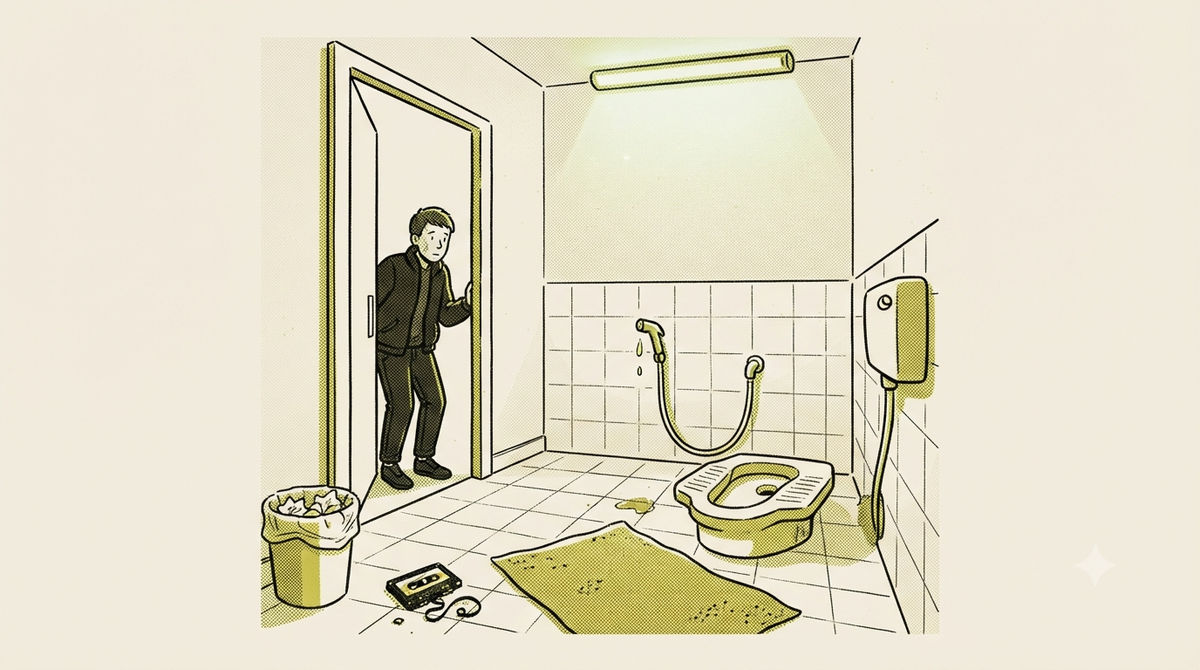
You walk into a public toilet at a metro station. You enter the third cubicle. The Indian-style pan is in front of you. A faint puddle around the rim. The flush button is partially blocked with what looks like dried mud. The hand-shower hose is dripping. There is no toilet paper. The door does not latch. You have not even started using the toilet yet.
What's actually happening
Most Indian public toilets exist in a self-reinforcing loop. The space is dirty, so the next user is careful only about themselves, not the space. They use the toilet, leave it slightly worse than they found it, walk out. The next user does the same. Maintenance shows up rarely. The loop continues until the toilet is unusable, at which point people start avoiding it, which means the maintenance team prioritises the ones still being used. It is a tragedy of the commons in tile.
The structural failure is real. Indian municipal sanitation budgets, staff allocation, and maintenance protocols are below working ratios in most cities. The Swachh Bharat Mission improved infrastructure but the CPHEEO advisory acknowledges that the operations layer is the harder problem.
You cannot fix the loop alone. You can refuse to be the user who makes it worse.
What works better
The Indian-style cubicle has a specific etiquette. Not "fancy" etiquette. The basic respect of leaving it usable for the next person.
Before you start:
- If a cubicle has visible filth, find another. If all are filthy, choose the cleanest.
- Latch the door if it latches. If not, hang your bag so it pushes the door from inside.
- Use the hook or hold your bag. Do not put it on the floor.
- Roll trousers above the ankles. The floor will have water.
While using:
- Position so splash stays inside the pan, not on the rim or floor.
- The hand-shower or mug is for cleaning yourself, not the toilet.
After:
- Flush. Twice if needed. Most Indian-style pans need a second flush.
- Use the hand-shower to rinse the rim if you splashed. Five seconds.
- Leave the door unlatched and ajar. Latched-with-no-one-inside is the most common cubicle confusion.
- Wash your hands with soap or sanitiser for 20 seconds. The WHO protocol is not negotiable.
Why it matters
Diarrhoeal disease, hepatitis A, and norovirus transmit through contaminated public-toilet surfaces. Handwashing with soap reduces diarrhoeal disease in the community by around 47% (Curtis and Cairncross, 2003). The 20-second soap-wash is the most cost-effective public-health intervention in the world.
The civic argument is independent of disease: the next person walking in is, statistically, similar to you. An office worker on a break. An older person who needs it now. A child whose parent is rushed. The cleaner you leave it, the better their next 60 seconds, and the better their exit for the person after them.
The loop only breaks when individual users decide to break it. There is no top-down fix coming.
Try this next time
For your next public toilet visit, spend an extra 30 seconds on the after-use cleanup. Notice that nothing about your day changes. The 30 seconds are real but small.
If you visit the same public toilet often (your office tower, your gym, your metro station) and it is consistently bad, file a maintenance complaint with the operating authority. Most metro stations have a complaint number on the wall. Most office towers have a facilities desk. Complaints work, especially if multiple users report the same toilet.
Quick check
1. You enter a public toilet cubicle and there is no toilet paper. The mounted hand-shower works. There is no soap at the basin outside. What do you do?
Select an answer.
2. You are about to walk out of a public-toilet cubicle. You used it normally, splashed water on the rim by accident, and you are slightly late for your meeting. What is the right exit move?
Select an answer.