Thailand temples: feet, photos, the Buddha rule
TL;DR
- In a Thai wat, where your soles point is a statement. Sitting with legs stretched toward a Buddha image reads as disrespect, so fold them back to one side.
- The dress standard is specific: sleeves for everyone, knees covered, sandals with a back strap. Shoes off at the door, and step over the raised threshold.
- Photos are usually fine. The rule is about people, not the building: never block someone who is praying or making a donation.
- A Buddha image cannot leave Thailand without a licence from the Fine Arts Department. Buy from a shop that does the paperwork, or leave it.
Contents
The moment
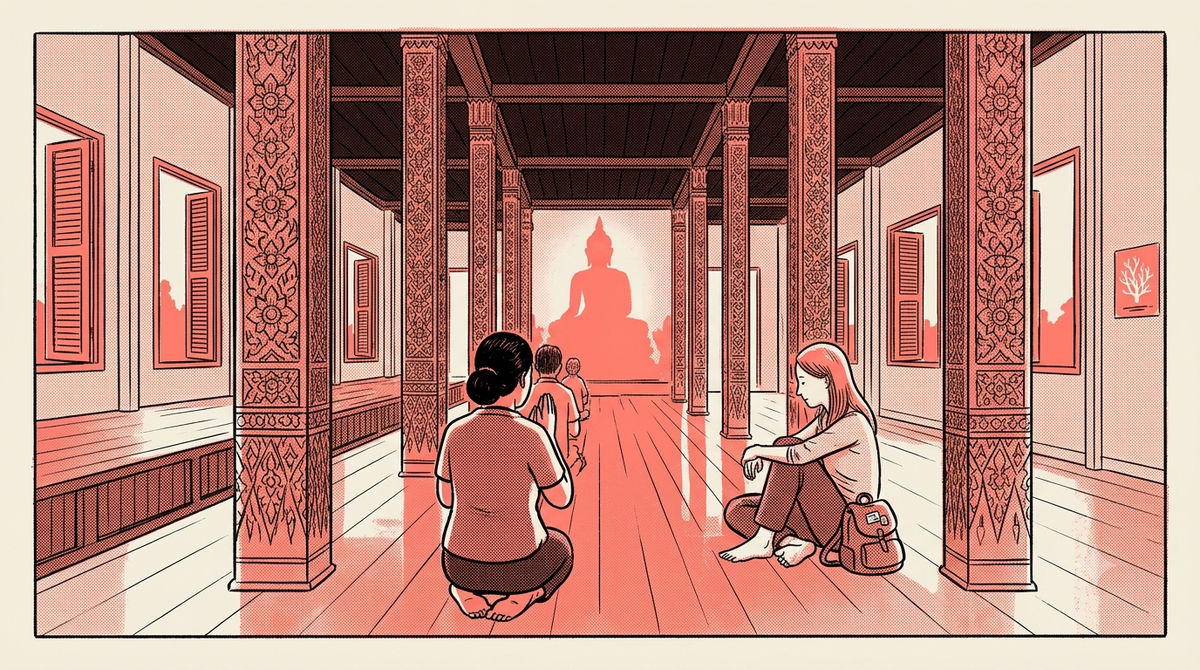
Ten in the morning at a wat in Chiang Mai. Your shoes are on the rack outside and the stone floor is cool. You sit down cross-legged near the back, and four minutes later your knees give up and you stretch your legs out in front of you. Comfortable. Also, meaning nothing by it, you have just pointed both soles at the Buddha image at the front of the hall.
What's actually happening
Nobody will say anything. Thai temples receive visitors warmly, and the staff have seen this twice already this morning. Which is exactly why it is worth getting right on your own.
The Tourism Authority of Thailand publishes the etiquette in plain language, and the feet rule is the first practical one. Sitting in front of a Buddha statue, your feet point away from it and never toward it. TAT names it as a sign of disrespect, not as a quirk.
The rest follows the same logic. Do not touch or point at the image. Walk around it clockwise. Do not raise yourself higher than it, which rules out the plinth as a photo platform.
Much of this you already know from home. Shoes come off at the door, and where your feet land is a statement. What travels badly is the assumption that a wat full of tourists has stopped being a working monastery.
What works better
Dress for the gate, not the weather. TAT's standard: for men, a shirt with sleeves and long trousers, or shorts that cover the knees. For women, a skirt longer than knee length and a top with sleeves, not spaghetti straps. Sandals need a back strap. A light scarf and full-length trousers in the day bag cover every stop.
At the door. Shoes off. Most temples have a raised threshold; step over it, never on it. Hat and sunglasses off, phone on silent.
Sitting. Fold your legs back to one side so the soles face away. Getting up, back away a short distance before you turn, rather than turning your back on the image.
Photos. Usually allowed. TAT's rule is about people, not the building: do not get in anyone's way for a shot, especially someone praying or making a donation. Save the cigarette for later too, since smoking in public in Thailand carries a fine of up to 5,000 baht.
The one you want to take home. Buddha images sit on the Thai government's restricted-export list, alongside art objects and antiques. Each needs a licence from the Fine Arts Department to leave the country. Buy from a shop that arranges the paperwork at the counter, or do not buy it.
Why it matters
A wat is a monastery that happens to be beautiful, not a monument that happens to have monks. The person kneeling three feet from you did not come for your photograph. The gap between a good visit and an awkward one is about six inches of foot placement.
The posted photo has its own afterlife. UK foreign office advice notes that posting pictures of people in clothing considered inappropriate can be illegal in Thailand. Both the uploader and the people in the frame can be fined or imprisoned.
Try this next time
Before you sit, decide where your soles will end up, and fold them back to one side before your knees decide for you.
And if you buy an image, ask for the export licence at the counter, in the shop, on the day. Not at the airport, where the answer is no.
Quick check
1. You are sitting on the floor of a temple hall in Ayutthaya, watching the light. Your legs have gone numb. The Buddha image is at the front of the hall, about ten metres away. What is the move?
Select an answer.
2. On your last afternoon in Bangkok you find a beautiful brass Buddha image in a market stall. The seller wraps it and says it will be fine in your check-in bag. What is the position?
Select an answer.