What you can take home, what you cannot
TL;DR
- Consumables (mini toiletries, tea sachets, disposable slippers) are priced into your stay. Take them without guilt.
- Towels, robes, hangers, and anything with a plug are washed, counted, and reused. They stay.
- Love the robe? Ask the front desk. Many hotels sell them, and some tag the price in the wardrobe.
- When unsure, ask. Front desks answer the can-I-take-this question every day.
Contents
The moment
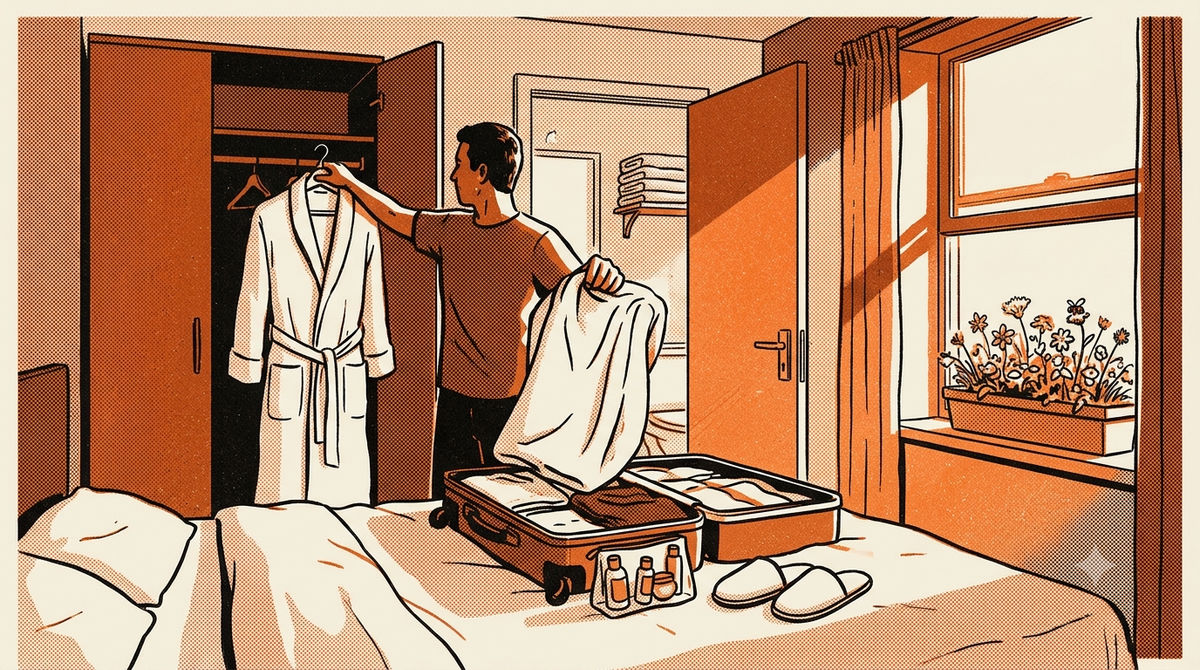
Checkout is at noon. Your suitcase is open on the bed. The mini shampoos and the sewing kit are already in your toiletry pouch, and that part is fine. Then your hand stops at the bathrobe, the thick white one you wore on the balcony both mornings. It would fit. The room cost ₹9,000 a night, so surely one robe is built into the price. The corridor is quiet. Nobody would see.
What's actually happening
There is a real line running through that suitcase, and it has nothing to do with being seen. It is the line between consumables and inventory.
The mini shampoo, the soap, the dental kit, the disposable slippers, the tea and coffee sachets, the notepad and pen: consumables. They are priced per stay, restocked for every guest, and designed to run out. Taking them home is the intended end of their life.
The towels, the robe, the hangers, the kettle, the hair dryer, the mugs: inventory. Bought once, washed and counted, meant to serve hundreds of guests. When one leaves in a suitcase, the hotel replaces it, and that cost moves quietly into everyone's room rate.
Hotels know exactly where this line sits. When Wellness Heaven surveyed 1,376 hoteliers on what goes missing from rooms, towels topped the list. 79.2% of hotels reported losing them, with bathrobes right behind (Source: Wellness Heaven, 2023). Many properties now tag the robe with a price, and will bill your card for a missing one without a conversation.
What works better
Take the consumables without guilt. If it is sealed, single-use, or designed to run out, it can travel. That is what it is there for.
Leave anything that gets washed, counted, or plugged in. Towels, robes, linen, hangers, mugs, the kettle. The hospitality trade has a one-line test for the appliances: if it has a plug, it stays (Source: KAYAK, 2025).
If you love the robe, ask at the front desk. Many hotels sell them, and some list the price on a tag in the wardrobe. A couple of thousand rupees at reception buys the robe and a clean conscience. The quiet-suitcase route buys the same robe plus a card charge and an awkward phone call.
Not sure which side something falls on? Ask. "Can I take the slippers?" is a normal question, and front desks answer it every day.
Why it matters
Run the hotel's math. A good bath towel costs a mid-range property several hundred rupees to replace. If one room in twenty packs one, a 200-room hotel loses towels by the dozen every month. That replacement line lands in the room rate every future guest pays. The packed robe is not a freebie; it is a small tax on the next traveller.
There is also the person who counts. Housekeeping reconciles the room after you leave. A missing robe becomes a tally that does not match, and a conversation someone else has to have.
Try this next time
At checkout, run the one-question test on anything you are tempted to pack: was this designed to run out, or designed to be washed and reused? Runs out, take it. Washed and reused, it stays. If you want it anyway, ask to buy it. Be the guest whose room tallies perfectly after the door clicks shut.
Quick check
1. You have fallen for the hotel bathrobe. It is checkout morning, the suitcase has space, and the corridor is quiet. What is the move?
Select an answer.
2. Which of these can go into your suitcase without a second thought?
Select an answer.