Tipping across cultures: USA, UK, Schengen, Singapore, Japan, UAE
TL;DR
- In the USA the tip is the server's wage: 18-20% at sit-down restaurants is the working norm, not generosity.
- UK and Schengen: 5-12.5% or round up, only when service isn't already on the bill.
- Japan and Singapore: don't tip. Cash left on a table in Japan may be politely returned.
- One question decodes any country: is the tip part of the wage here, or a gesture?
Contents
The cultural moment
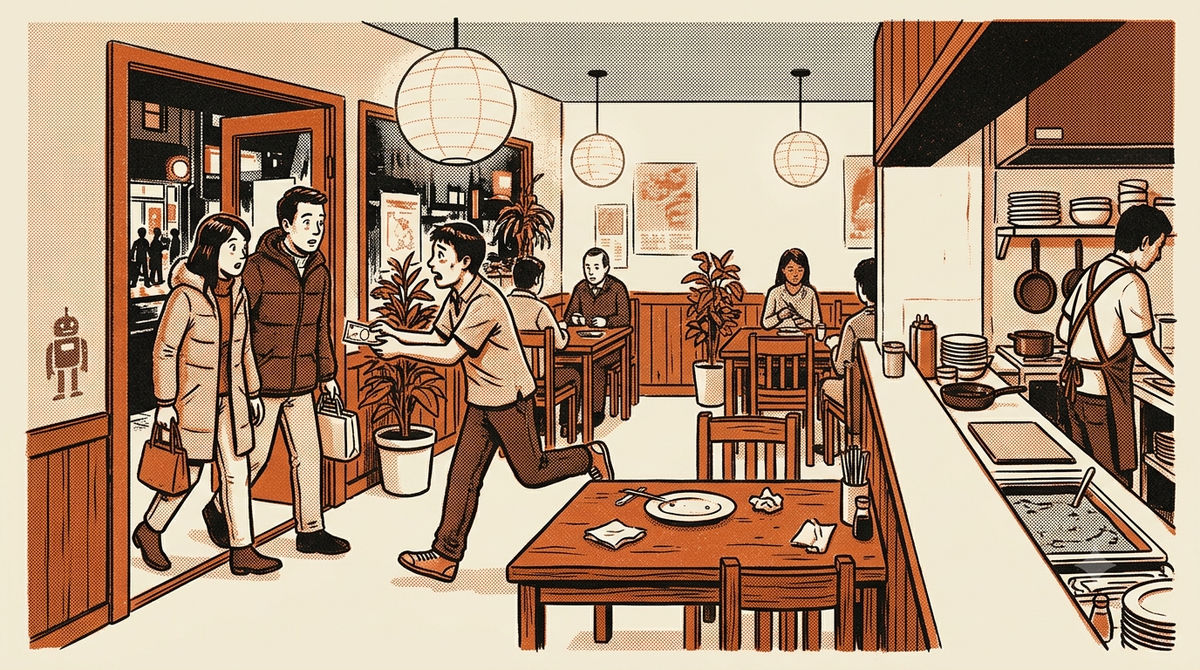
The bill arrives, and you are not in India. What happens in the next thirty seconds is one of the most local things about any country: whether a tip is expected, how much, and what the tip actually is. In some countries it is the server's wage. In others it is a gesture. In a few it is a small social error.
How it shows up across contexts
| Context | What's normal | Why it works there |
|---|---|---|
| In India (full-service restaurants) | 5-10% in cash when no service charge is on the bill. A printed service charge is voluntary and removable on request. | Tips supplement modest base pay. Cash handed over reaches the server; app tips often pool with the company. |
| In India (dhabas, casual, takeaway) | ₹10-50, or nothing at all. Counters and takeaway: no tip. | The transaction is direct and the price is the price. |
| In the USA | 18-20% at sit-down restaurants, near-obligatory. Counter screens may prompt; smaller amounts are fine there. | The federal minimum cash wage for tipped workers is $2.13 an hour. The tip is not gratitude. It is the wage. |
| In the UK | 10-12.5% in restaurants when no service charge is added. No tipping at the pub bar. | Since the Employment (Allocation of Tips) Act 2023, all tips must be passed to workers without deductions. |
| In Schengen Europe | Round up, or 5-10% for table service. Service is often already included in the menu price. | Servers are salaried staff on regular contracts. The tip is appreciation, not income. |
| In Singapore | No tipping culture. A service charge commonly appears on restaurant bills; leave it at that. | Wages are built into the bill. Extra cash on the table mostly confuses the handover. |
| In Japan | No tipping. Cash left on a table may be politely returned to you. | Excellent service is the default, not a tipped extra. The one exception, kokorozuke, is an envelope gratuity in specific settings like ryokan attendants and private guides. |
| In the UAE | Service charge is common at hotels and restaurants. Small cash notes for valets, porters, and delivery are appreciated, not demanded. | A large service workforce runs daily life; small cash gestures are the working norm. |
The translation move
A tip is not a universal constant. It is a wage-system artifact. So ask one question when you land: is the tip part of the wage here, or a gesture?
Where it is the wage (the USA), budget it into the meal. A 20% tip on a $60 dinner is roughly ₹1,000. Treat it as part of the price you agreed to when you sat down. Skipping it takes money out of the server's paycheck, not out of the restaurant's margin.
Where it is a gesture (the UK, Schengen, the UAE), match the local range and stop there. Check the bill first; if service is already included, you are done.
Where it does not exist (Japan, Singapore), the respectful move is to not import it. Gratitude travels in words there. Say the thank-you, keep the note.
No system on this table is more correct than another. Each is internally consistent: the American tip funds a wage, the Japanese no-tip funds a standard, the Indian cash tip reaches a person.
Try this next time
Before your next international trip, look up two numbers for the destination: the restaurant percentage and the taxi norm. Decide your rule on day one, not table by table. For a US trip, add 20% to your food budget before you leave. For Japan or Singapore, practice the sentence you'll say instead of the tip you'll leave.
Quick check
1. Dinner for two at a sit-down restaurant in Chicago comes to $60. The service was fine, nothing memorable. The card machine offers 18%, 20%, 25%, and custom. What's the right move?
Select an answer.
2. A small restaurant in Kyoto. The service was the best of your trip. You leave ¥1,000 under your plate as thanks and head for the door. What's likely to happen, and what would have worked better?
Select an answer.