Monasteries in India and abroad: the bow, the kora, the hush
TL;DR
- A monastery is a residence and a workplace, not a monument with monks in it. Amaravati in England houses about 60 people; the day starts at 5 am and was not scheduled around your visit.
- The bow: no handshake. Amaravati's own guidance is to avoid physical contact and greet with anjali, hands raised palm to palm at chest level.
- The kora: walk the circling path clockwise, so the building stays on your right. Tibetan Buddhists go clockwise; Bon pilgrims traditionally go the other way, and each is correct at its own site.
- The hush is really the schedule. Bodh Gaya's Mahabodhi Mahavihara opens at 5 am, chants at 5:30 am, 6 pm and 6:30 pm, and closes at 9 pm. Arriving mid-session is fine. Talking through it is not.
Contents
The moment
A monastery above a mountain road, 7:40 am. The courtyard is empty except for two monks carrying water, and there is a low drumming from the hall. You do not know whether you can go in, which way to walk around the building, or whether to say something. Your phone is in your hand, and you are not sure about that either.
What's actually happening
A monastery is not a monument with monks in it. It is a residence and a workplace. Amaravati, the Theravada monastery in Hertfordshire, houses about 60 people: 25 monks, 10 nuns, 25 lay residents and guests. Its day starts at 5 am with silent meditation and chanting. You have walked into somebody's Tuesday.
Three things get you through most Buddhist monasteries, Theravada or Tibetan.
The bow. Nobody expects you to prostrate. Amaravati's own guidance is plain: avoid physical contact, and the most suitable greeting is anjali, the hands raised palm to palm at chest level. No handshake. That is the entire greeting.
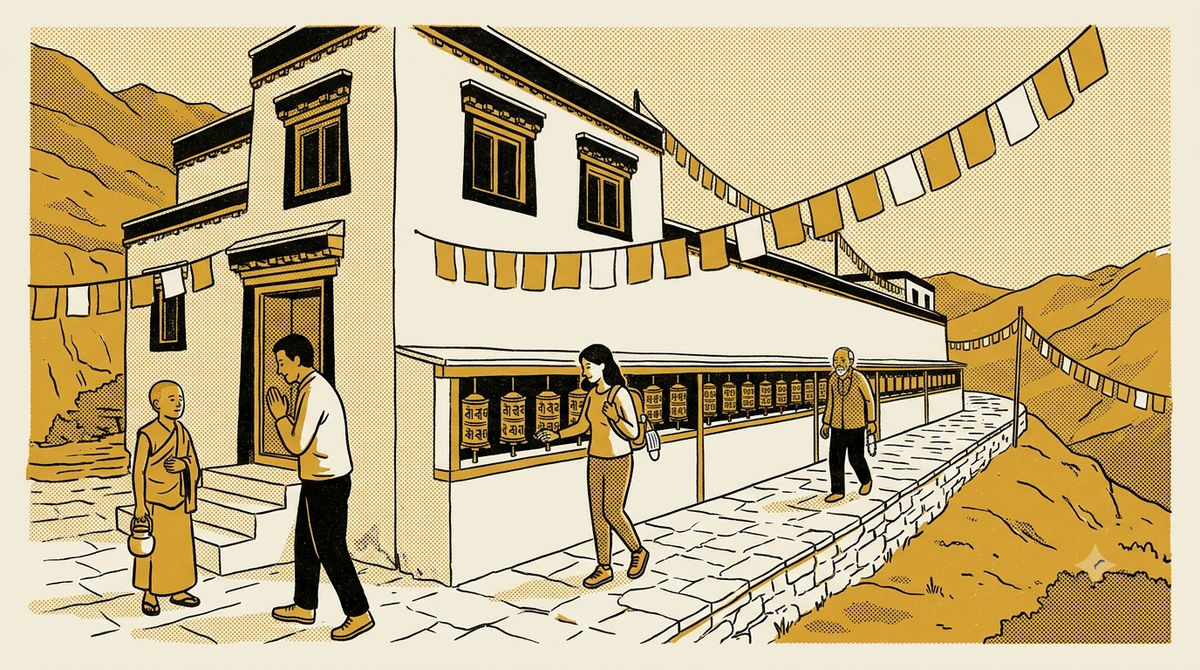
The kora. Kora is the Tibetan word for walking around a sacred place, done as both pilgrimage and meditation. Most gompas in Ladakh, Sikkim and Dharamsala have a path for it. Tibetan Buddhists walk it clockwise, which keeps the building on your right. Bon pilgrims traditionally walk the other way. Neither is a mistake; each is correct at its own site.
The hush. What catches visitors out is the timetable, not the volume. Bodh Gaya's Mahabodhi Mahavihara opens at 5 am and shuts at 9 pm. Sutta chanting runs from 5:30 am, kheer is offered at 10, and there is chanting again at 6 pm and 6:30 pm. Arriving mid-session is fine. Talking through one is not.
What works better
Plan around their clock, not yours. Amaravati suggests the mealtime, tea at 5 pm, or the evening puja at 7:30. Bodh Gaya publishes its chanting hours. A monastery that tells you when to come is doing you a favour.
Anjali, then wait. Palms together at chest height, small nod. No handshake, no arm around a monk for a photo.
Keep the building on your right. Walk the path the way everyone else is walking it. If you keep meeting people head-on, turn around.
Shoes off, phone away, elbows and knees covered. Amaravati asks for loose clothes covering elbows, collar and knees, because you will be sitting on the floor. Slip-ons help, since footwear comes off at every building.
Sit before you look. In the hall, take a spot at the back and stay still for a minute before looking around. Do not walk between a seated practitioner and the shrine.
Money is not the offering you assume. In this tradition monks and nuns cannot accept money at all, or consume anything except water that was not formally offered. There is a donation box. Use it, and stop there.
Why it matters
Almost every place you enter in a week wants your attention or your money. A monastery wants neither. Entry is usually free and the community runs on donations. That holds only while visitors treat the place as a house they were let into, not an attraction they paid for.
Try this next time
Look up two things: the opening hours and the chanting times. Arrive fifteen minutes before one.
Then, at the gate: phone on silent, shoes off at the hall, palms together if anyone greets you, building on your right. Be the visitor nobody has to redirect.
Quick check
1. You are at a Theravada monastery and a monk has spent ten minutes answering your questions. You want to thank him properly. What is the move?
Select an answer.
2. You reach a hilltop Tibetan Buddhist monastery and find a worn stone path ringing the whole building, with a line of prayer wheels along the wall. Which way do you walk it?
Select an answer.