Jain derasars: the leather rule, the cleaning rule, the silence
TL;DR
- The three rules that catch visitors out at a Jain derasar are leather, cleanliness and quiet. All three are about what you leave outside, not what you perform inside.
- Leather stays out: belt, wallet, watch strap, bag, camera case. Dilwara at Mount Abu also bars cameras and phones outright, and asks for shoulders and knees covered.
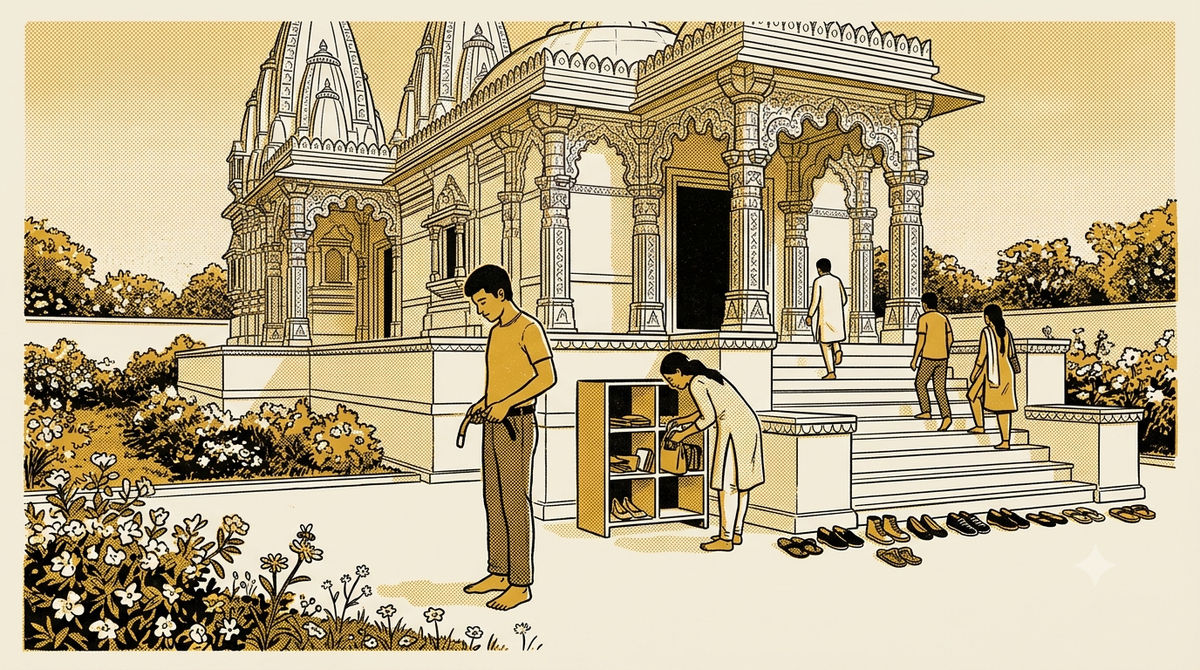
- Shoes come off at the foot of the steps, not at the door. Every Jain temple sits on a raised platform, and the platform is where the sacred area begins.
- Major derasars split the day: worship in the morning, visitors after noon. At Dilwara that is 6 am to noon for devotees, noon onward for everyone else. Entry is free.
Contents
The moment
Mount Abu, a December morning, and you have driven up to see Dilwara. You reach the gate at 11:20. A board says visitors from noon. You are also wearing a leather belt, carrying a leather wallet and holding a phone. That is four problems: the clock, the belt, the wallet and the phone. The queue behind you is growing.
What's actually happening
A derasar runs on three rules that catch first-time visitors out: leather, cleanliness and quiet. All three are about what you leave outside. None of them ask you to perform anything inside.
The leather rule comes straight from the tradition's founding principle. In the Institute of Jainology's own words, compassion and non-violence towards all living beings are the fundamental principles of Jain philosophy. Leather is an animal. So the belt, the wallet, the watch strap, the handbag and the camera case stay out. The Ministry of Tourism's own page for Dilwara puts it plainly: cameras, mobile phones and leather items are strictly prohibited, and shoulders and knees must be covered.
The building tells you where the line is. Every Jain temple sits on a raised platform, the jagati, and almost all sit inside a high compound wall. The platform is not decoration; it marks off the sacred area from the ordinary ground around it. Shoes come off before you climb it, and that short ascent stands for durlabha, the difficulty of reaching sacred places.
The morning is not yours. At Dilwara, worship runs 6 am to noon and visitors come after. Entry is free.
What works better
Empty your pockets in the car park. Belt off, wallet, watch strap, bag, phone, camera. Ten seconds there saves a negotiation at the gate. Most large derasars have lockers.
Time it for the afternoon. If a derasar splits its day, the morning belongs to worship. Turning up at 11:40 and asking to be let in early is the wrong favour to ask.
Shoes at the steps, not at the door. Look for where everyone else's footwear stops. That line is the edge of the platform, and the actual threshold.
Come clean and covered. Dilwara's published requirement is shoulders and knees covered. Fresh clothes and clean hands are the ordinary courtesy anywhere else. Eat before you go in, not on the steps.
Quiet, and slower than you think. If people are circling the shrine, they are walking pradakshina. Join the same direction or step to the side. Do not cut across.
Read the board at the entrance. Derasars differ by tradition and by trust; Digambara and Shvetambara customs are not identical, and each temple sets its own rules. Whatever is posted at that gate is the rule for that gate. It beats anything you read beforehand, including this.
Why it matters
Most faith sites ask you to add something: cover your head, fold your hands, drop a note in the box. A derasar mostly asks you to subtract. You do not need to know a prayer, a name or a gesture. Taking off a belt and putting a phone away is the entire ask. That is a low bar for a building other people have kept spotless for centuries.
Try this next time
Before your next derasar visit, do the car park check: belt, wallet, watch, bag and phone into the glovebox. Look up the visitor timings first, while you still have the phone.
Then walk up, leave your shoes where everyone else's are, and read the board. Be the visitor who already knew about the leather.
Quick check
1. You reach the Dilwara temples at Mount Abu at 11:20 am, wearing a leather belt and carrying your phone and wallet. What actually happens next, and what should you do?
Select an answer.
2. At a large derasar you notice everyone's shoes stopped at the bottom of a flight of steps, well before the temple door. Why there, and what do you do?
Select an answer.