Dargah etiquette: the chadar, the qawwali, the heads-down rule
TL;DR
- Dargahs are Muslim shrines (mausoleums of Sufi saints) AND historic shared devotional spaces. Hindu families have offered chadars at Ajmer Sharif for 700+ years. The pluralist tradition has its own respectful protocol.
- The three pillars: chadar offering (₹100-5000, intention not price), qawwali (Thursday evenings at Nizamuddin, daily during Urs at Ajmer), and the heads-down rule near the tomb.
- Head covered, shoes off, modest clothes, no flash. Buy a scarf/dupatta/skullcap (₹30-100) at the gate if you forgot one. Walk slowly, voice low, do not push the queue.
- Inner-sanctum access has been clarified legally. The 2016 Bombay HC ruling in the Haji Ali PIL held the women's-entry ban unconstitutional under Articles 14, 15, 25. Some dargahs still use traditional jaali access; both are constitutionally valid practice.
Contents
The moment
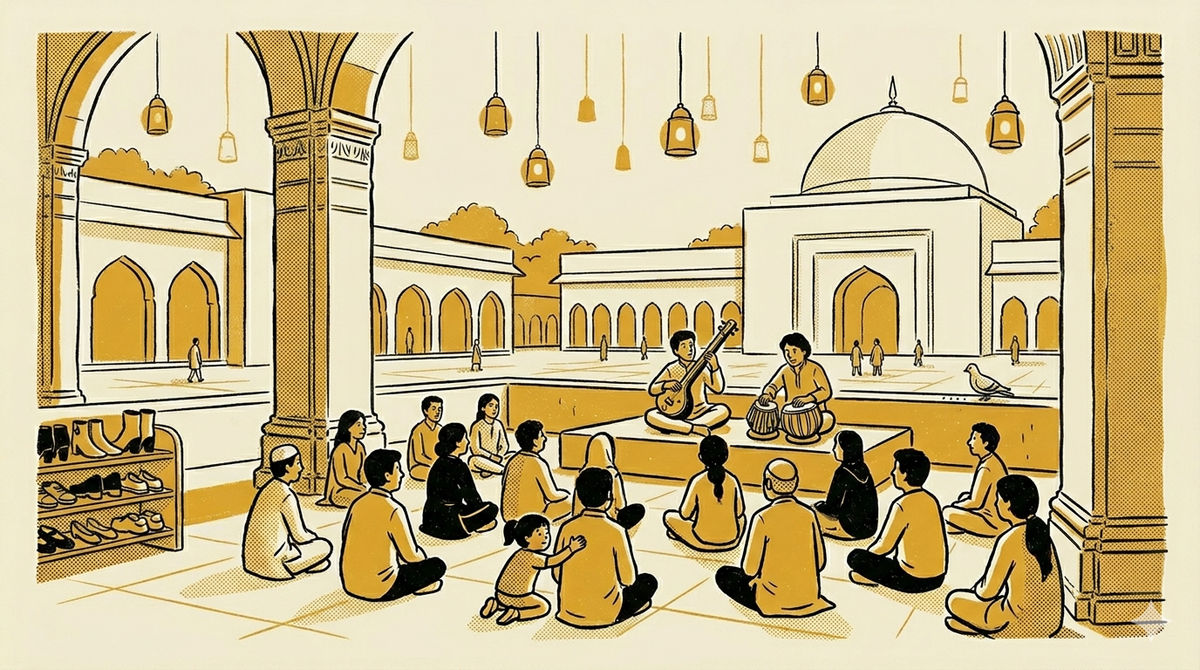
You are at Nizamuddin Auliya's Dargah in Delhi on a Thursday evening. The qawwali has just begun under the dome. The courtyard is packed. Hindu families, Muslim families, students, foreign tourists, all listening to the same Sufi devotional music written 700 years ago. A child sits on her father's shoulders to see. Chadars draped on the tomb glow under the green lights. You took off your shoes at the gate; the floor is cool. You realise you are a guest at one of India's longest continuous interfaith traditions.
What's actually happening
Dargahs are mausoleums of Sufi saints. Muslim religious sites, historically open to all faiths. Ajmer Sharif (Khwaja Moinuddin Chishti), Nizamuddin Auliya, Salim Chishti at Fatehpur Sikri, Haji Ali: all four draw chadar-offering pilgrims from every community. The cross-faith devotional practice predates the modern Indian state by centuries.
The visitor protocol is a Muslim religious protocol adapted for the cross-faith reality. The basics: head covered, modest clothes, shoes off, no flash, no loud conversation. The chadar is the traditional offering; flowers, ittar, and sweets also work. Qawwali is the Sufi devotional music tradition: Thursday evenings at Nizamuddin, daily during Urs at Ajmer.
Inner-sanctum access has been clarified legally. The 2016 Bombay HC ruling in the Haji Ali PIL (filed by Bharatiya Muslim Mahila Andolan) held the women's-entry ban unconstitutional under Articles 14, 15, 25. Some dargahs (Nizamuddin among them) still operate with traditional jaali access for women. The constitutional bar is clarified; operational practice varies.
What works better
Before you go. Check hours and the day's significance (Thursday qawwali at Nizamuddin; calmer weekday mornings elsewhere). Modest clothes, shoulders and knees covered. Buy a scarf, dupatta, or skullcap at the gate stalls (₹30-100). Ankle-easy footwear.
At the entrance. Head covered. Shoes off. Phone on silent. If carrying a chadar, gate staff will guide. The chadar can be simple cotton (₹100-300) or richly embroidered (₹500-5000); intention matters, not price.
Inside. Walk slowly. Stay to the right of the flow. The khadim (caretaker) will guide your chadar-offering moment. Do not push the queue. Voice low.
During qawwali. Sit cross-legged if you can. Move with the wave of the audience. You may clap or sway, never shout. Tipping (₹50-200) at the end is customary.
The heads-down rule. Near the tomb, eyes respectful, head bowed. Do not stare at the tomb, the calligraphy, or other worshippers. The universal gesture of being a guest at someone else's saint's mausoleum.
Why it matters
Dargahs are one of India's longest pluralist civic traditions. Hindu families have offered chadars at Ajmer Sharif for 700+ years; the practice is older than most Indian states. The respectful visitor protocol is how the tradition continues across communities.
The legal frame matches the practice. Major dargahs are protected under the Wakf Act 1995. Ajmer Sharif and Salim Chishti also fall under AMASR 1958 §30 as centrally protected monuments. The 2016 Bombay HC women's-entry ruling brought the inner sanctum under Articles 14, 15, 25. Behaviour and law point the same direction.
Try this next time
If you have never visited a dargah, pick the closest major one. Ajmer Sharif from Delhi or Jaipur; Nizamuddin in Delhi; Haji Ali in Mumbai. Weekday morning. Carry scarf or cap and a simple chadar. The tradition explains itself to those who pay attention.
If you bring children, brief them before: "We are guests here. The shrine is sacred to many people. Quiet voice, head covered, no running."
Quick check
1. You are a Hindu family planning your first visit to Ajmer Sharif. Your kids are 8 and 11. What is the most useful preparation move?
Select an answer.
2. You are at Nizamuddin Auliya's Dargah on a Thursday evening for the qawwali. The courtyard is full. A foreign tourist next to you raises their phone with flash on to record the qawwals. What is the right move?
Select an answer.
Sources
- Dr. Noorjehan Safia Niaz and Anr. v. State of Maharashtra and Ors. (Haji Ali Dargah women's entry case, August 2016)
- Ancient Monuments and Archaeological Sites and Remains Act, 1958, Section 30 (Penalties), as amended by Act 10 of 2010
- The Wakf Act, 1995 (as amended by the Wakf (Amendment) Act, 2013)
- Hazrat Nizamuddin Aulia Dargah, New Delhi (official site)