Crowd surges and how not to die in one
TL;DR
- Crowd-crush deaths are not crushing. They are asphyxiation in 30 to 90 seconds. The physics is the same at Sabarimala, at Mina, and at any large gathering anywhere.
- The density to watch is 5 people per sqm (max safe) and 6+ (high risk). At 6+, surges propagate and people in the middle of the crowd cannot expand their lungs.
- If a surge starts: stay on your feet, keep arms up boxer-style, move with the wave not against it, edge sideways to a wall or low-density area, never push forward.
- The biggest civic move is the one nobody thinks about: if you are in the back of a stopped crowd, do not push forward. Most surges escalate from the back not knowing the front has stopped.
Contents
The moment
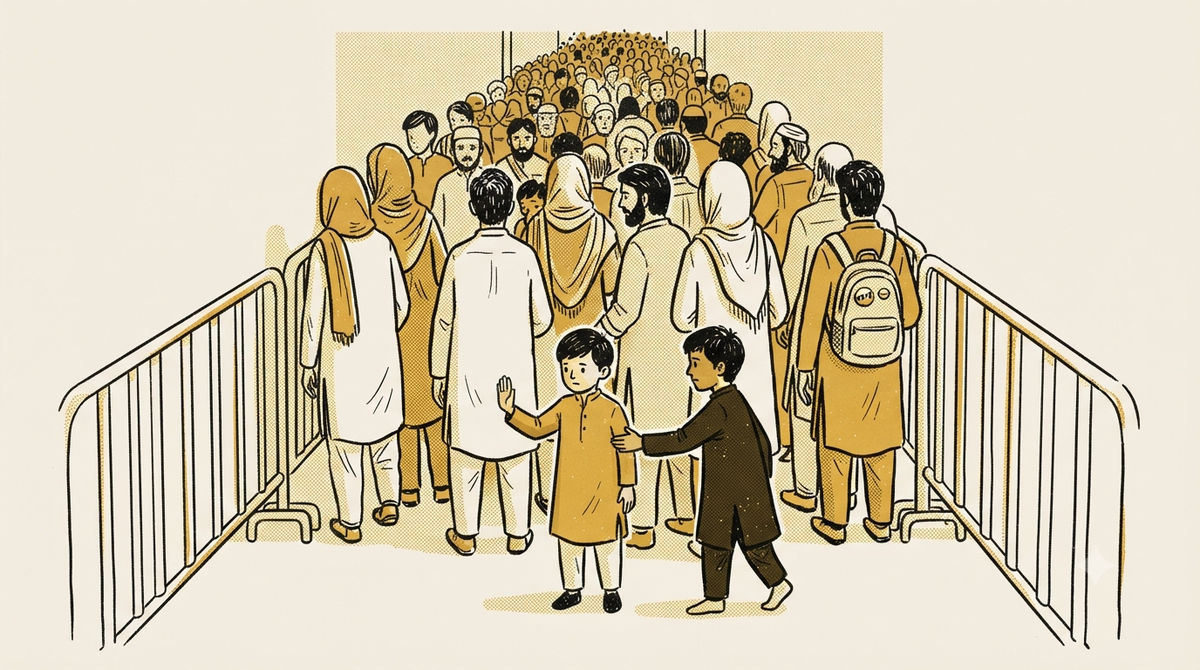
You are in a darshan queue at Sabarimala on a January morning. The queue has been moving steadily for an hour. Suddenly the people behind press harder. Your feet leave the ground for a half-second. You cannot expand your chest fully. Someone shouts. The crowd ahead, you realise, has stopped moving. The crowd behind has not. You are in what crowd scientists call a compressive surge. If it does not release in 90 seconds, people will die.
What's actually happening
Crowd-crush deaths are not crushing. They are asphyxiation. Above about 6 people per square metre, the crowd moves as a fluid. When the fluid hits a constriction (narrow gate, step-down, fallen person), pressure builds backward. People in the middle cannot expand their lungs. Death by compressive asphyxiation occurs in 30 to 90 seconds. Helbing and Mukerji established this in the 2012 analysis of the Duisburg Love Parade.
India's named religious-gathering disasters include Mandhar Devi 2005, Naina Devi 2008, Sabarimala 2011, Ratangarh 2013, Vaishno Devi 2022, Hathras 2024. The pattern repeats: large crowd, narrow approach, sudden trigger, deaths. The same physics drives Mina (Hajj 2015) and Duisburg (Love Parade 2010). This is universal crowd physics, not any tradition's problem.
The lesson is partly civic (do not worsen the surge) and partly personal-safety (recognise and exit).
What works better
Before you go. Avoid peak windows if you can. Shahi-snan days at Kumbh, famous-temple festival nights, peak-day darshan. Off-peak gives you 90% of the experience at 10% of the risk. Wear shoes you can walk in (not slippers). Note medical-aid posts and exits as you arrive.
Read the density. Published thresholds: 5 per sqm is max safe, 6+ is high risk, 7+ is where surges propagate and lives are at risk (Still, gkstill.com). At 5+, edge sideways toward a wall or low-density area. Do not push. Do not shout, it triggers panic.
If a surge starts. Stay on your feet at all costs; a fall is potentially fatal because you cannot get back up. Keep arms up, fists near your chest like a boxer, to protect lung expansion. Move with the wave, not against it. Look for diagonal escape routes sideways toward an edge, not forward.
If you are with kids or elderly. Do not separate. Carry the child or put them on your shoulders. If you lose hold, stop, get to a wall, wait. Do not search forward into denser crowd.
Do not worsen the surge. If you are in the back of a stopped crowd, do not push forward. Most surges escalate from "the back does not know the front has stopped." Default to not transmitting pressure. If someone falls, reach down and help them up. Five seconds prevents a chain of falls.
Why it matters
The NDMA 2014 guidelines identify religious gatherings as the highest-risk crowd events in India, and acknowledge that organisational measures (barricading, capacity limits, route management) consistently lag attendance. Visitor behaviour is therefore a real safety variable. Your behaviour in a dense crowd may save someone's life or end someone's life. Both are real outcomes within your control.
Try this next time
If you are planning a known high-density event, look up the venue's past incidents and pinch points before you go. On arrival, scout exits, medical posts, and lower-density side areas. If density rises above your comfort, leave. The darshan can wait.
Quick check
1. You are in a crowd at Kumbh Mela approaching a key bathing ghat. Density is rising. You can feel the people behind you pressing harder. What is the right move?
Select an answer.
2. You are at the back of a large crowd at a religious event. The crowd has been stopped for two minutes. People behind you are starting to push. What is the most useful next move?
Select an answer.
Sources
- Managing Crowd at Events and Venues of Mass Gathering: A Guide for State Governments, Local Authorities, Administrators and Organizers
- Crowd disasters as systemic failures: analysis of the Love Parade disaster
- Standing Crowd Density
- 2024 Hathras crowd crush (overview of investigation and casualty figures)