ASI sites: what's protected, what's not, why it matters
TL;DR
- Protection in India has three tiers, not one. Centrally protected under ASI, state protected under each state's own Act, and everything else, which is most of it.
- Age alone protects nothing. The Act's definition of an ancient monument starts at 100 years old, but that only makes a structure eligible. Somebody still has to notify it.
- Around a centrally protected monument, the first 100 metres is prohibited area where nobody but an archaeological officer may build, and the next 200 metres is regulated area where you need permission.
- In March 2026 the government told the Lok Sabha that 36,083 cases of illegal construction had been reported inside those rings, across 3,686 monuments. That is roughly ten each.
Contents
The moment
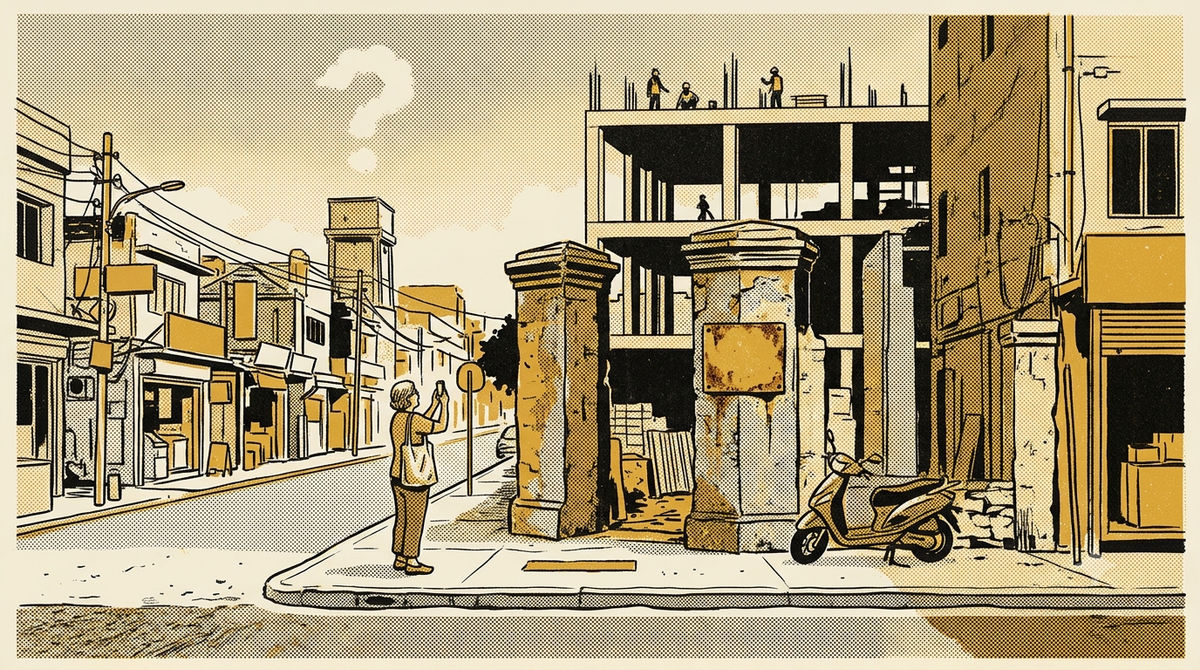
You stop at the old stone gateway at the end of your street. It is centuries old, attached to nothing, and nobody on the road knows what it was. A rusted board is bolted to one pier, too faded to read. Twenty metres behind it a concrete frame is going up, three storeys and climbing. You wonder whether either thing means anything legally, and whether it is anyone's job to care.
What's actually happening
Protection in India has three tiers, and almost everyone assumes there is one.
Centrally protected. In March 2026 the government told the Lok Sabha there are 3,686 protected monuments and sites under the Archaeological Survey of India. They are spread unevenly: Uttar Pradesh has 734, Karnataka 506, Tamil Nadu 412, Delhi 170, Manipur one. The list belongs to no single tradition. ASI's own description of it runs through stupas, temples, churches, synagogues, mosques, tombs, palaces, forts, bathing ghats, bridges and kos minars.
State protected. Every state and union territory declares its own monuments of state importance under its own Act. Different list, different office.
Everything else. This is most of it. INTACH has listed about 52,000 buildings across 170 cities. A listing is an inventory, not a legal shield.
Age by itself protects nothing. The Act's definition of an ancient monument begins at 100 years old, which makes a structure eligible. Somebody still has to notify it.
Around a centrally protected monument the law draws two rings. The first 100 metres is prohibited area, where nobody but an archaeological officer may build. The next 200 metres is regulated area, where construction needs permission from the competent authority on the National Monuments Authority's recommendation.
What works better
Find out which tier it is. ASI publishes its list state by state. Ten minutes tells you whether that gateway is tier one, tier three, or your state's.
Read the rings, not the fence. A monument's boundary is the start of a 100-metre no-build zone, not the end of the rules. Building in the inner ring, or in the outer one without permission, carries up to two years imprisonment, a fine up to ₹1 lakh, or both.
Know what you are entitled to. The Act gives the public a right of access to any protected monument. Some charge entry. Still photography is generally allowed; filming needs permission.
Report construction, and be specific. The stated process is notices, police complaint, stoppage, then demolition through the district administration. Note the date, address and distance.
If it is tier three, you are the protection. Municipal heritage cells and INTACH chapters are where unprotected buildings get documented before they come down. Documentation is thin; dated photographs help.
Why it matters
In that same reply, the government said 36,083 cases of illegal construction had been reported inside prohibited and regulated areas. Across 3,686 monuments that is roughly ten each, at the sites with the strongest protection India offers.
Most heritage is not lost to someone carving a name at Hampi. It goes quietly, on an ordinary Tuesday, from a building nobody listed and nobody could name an office for.
Try this next time
Pick one old structure near you and find out its tier. Search ASI's state list first, then your state archaeology department's.
If it is centrally protected, pace out 100 metres and look at what is standing there. If it is not protected at all, the likelier answer, take five dated photographs and send them to your city's INTACH chapter. That is the whole ask.
Quick check
1. A builder is putting up a four-storey block about 60 metres from a centrally protected fort wall. The site office says the fort is fine because nobody has touched it. Is that right?
Select an answer.
2. A 150-year-old haveli in your neighbourhood is about to be demolished. A neighbour says it cannot be touched because anything over 100 years old is automatically protected. What is actually true?
Select an answer.
Sources
- The Ancient Monuments and Archaeological Sites and Remains Act, 1958 (24 of 1958), as amended by the Ancient Monuments and Archaeological Sites and Remains (Amendment and Validation) Act, 2010 (10 of 2010)
- Monuments
- Conservation and Protection of Monuments of National Importance (Lok Sabha written reply, Release ID 2243786)
- INTACH Listings