The morning-walker, evening-walker truce
TL;DR
- A neighbourhood park is shared by time as much as space: a morning crowd and an evening crowd on the same finite loop.
- Follow the loop. Watch which way the regulars walk and join it; if you are faster, keep to the edge and overtake on one side.
- Keep your audio in your head. Earphones for music, calls stepped off the track and kept low, group workouts without a speaker that reaches the far gate.
- Residential daytime noise limits run as low as 55 dB, and most parks sit inside a residential zone.
Contents
The moment
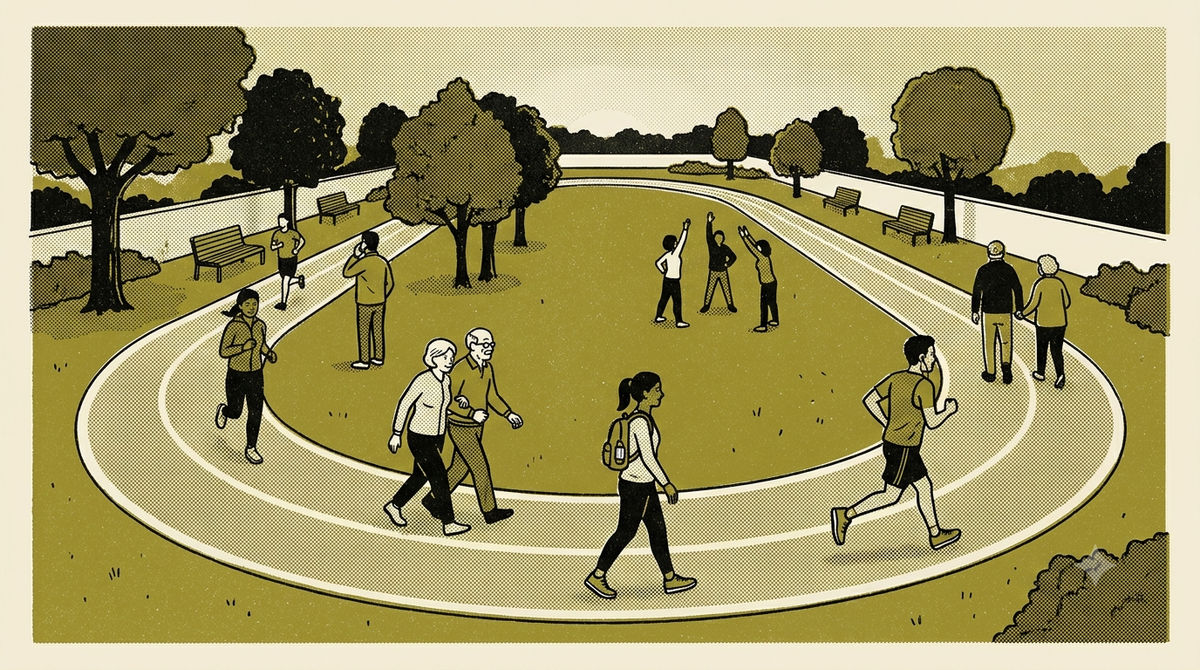
It is 6:15 am at the neighbourhood park. The walking track is busy in both directions at once. An older couple does brisk laps one way. A young man jogs the other way, weaving through them, earphones in. On the central lawn a group does loud group exercise with a portable speaker turned up for the whole park to hear. By the gate a man takes a call on speaker, mid-walk. By 6 pm the same track belongs to a different crowd: kids on cycles, families, after-work runners. One track, one lawn, two shifts, and a hundred small ways to get in each other's way.
What's actually happening
A neighbourhood park is shared by time as much as by space. The morning belongs partly to the laps-and-stretches crowd, the evening partly to families and runners. The park was built for all of them on the same finite loop. The friction is rarely malice. It is a lot of people using one space with no agreed rules, so everyone improvises and the improvisations collide.
Two habits cause most of it. The first is the speaker. One group's music, or one walker's speakerphone, fills a space dozens of people came to for quiet. The Noise Pollution (Regulation and Control) Rules, 2000 set daytime limits as low as 55 dB in residential zones, and most parks sit inside one (Source: Noise Pollution Rules, 2000). The second is direction and pace: fast movers cutting across slow walkers, with no shared sense of which way the loop runs.
What works better
Follow the loop. Most tracks settle into a direction; watch which way the regulars go and join it. If you are faster, keep to the outer edge and overtake on one consistent side, the way you would want to be passed.
Keep your audio in your head. Earphones for your music, your call stepped off the track and kept low. A group workout can happen without a speaker that reaches the far gate. If you want music, keep it to your own corner and your own volume.
Share the shifts. The 6 am crowd does not own the park any more than the 6 pm crowd does. If your group takes the central lawn each morning, leave room, and leave it as you found it. The evening families will want the same lawn.
Why it matters
For most Indians the neighbourhood park is the only free, open, daily exercise space there is. Walking is one of the cheapest things a body can do for itself (Source: WHO Physical Activity Guidelines). A park that works at both 6 am and 6 pm does more public-health work than any gym. It serves the eighty-year-old on her laps and the eight-year-old on his cycle alike.
None of the fixes need a committee. They need each user to assume the space is shared, and to behave as if the next shift matters. The truce is not a rule anyone enforces. It is a hundred people each deciding the loop is not theirs alone.
Try this next time
Tomorrow at the park, do one of these. Walk the direction the regulars walk instead of against them. Put your call on earphones, or step off the track and keep it low. Or, if your morning group runs a speaker, try one lap with it off and notice the park you have handed back to everyone else on it.
Quick check
1. Your morning group does a daily workout with a portable speaker that carries across the whole park. Others are walking quietly. What is the better default?
Select an answer.
2. The walking track has no signs, but most regulars walk anticlockwise. You would rather go clockwise. What is the move?
Select an answer.