Playgrounds, and which equipment is for which age
TL;DR
- Playground equipment is built in age bands. The toddler swing, the small slide, and the tall climbing frame are not interchangeable.
- Match the child to the equipment: little ones in the toddler zone, bigger kids on the big frame, where it is safer and usually more fun.
- If you are an older child or an adult, the small swings and spring riders are not yours, however free they look. You also bend and break them.
- A colony park has one toddler swing for a whole neighbourhood of toddlers. Take turns and hand it over; the equipment runs on the same rotation as everything shared.
Contents
The moment
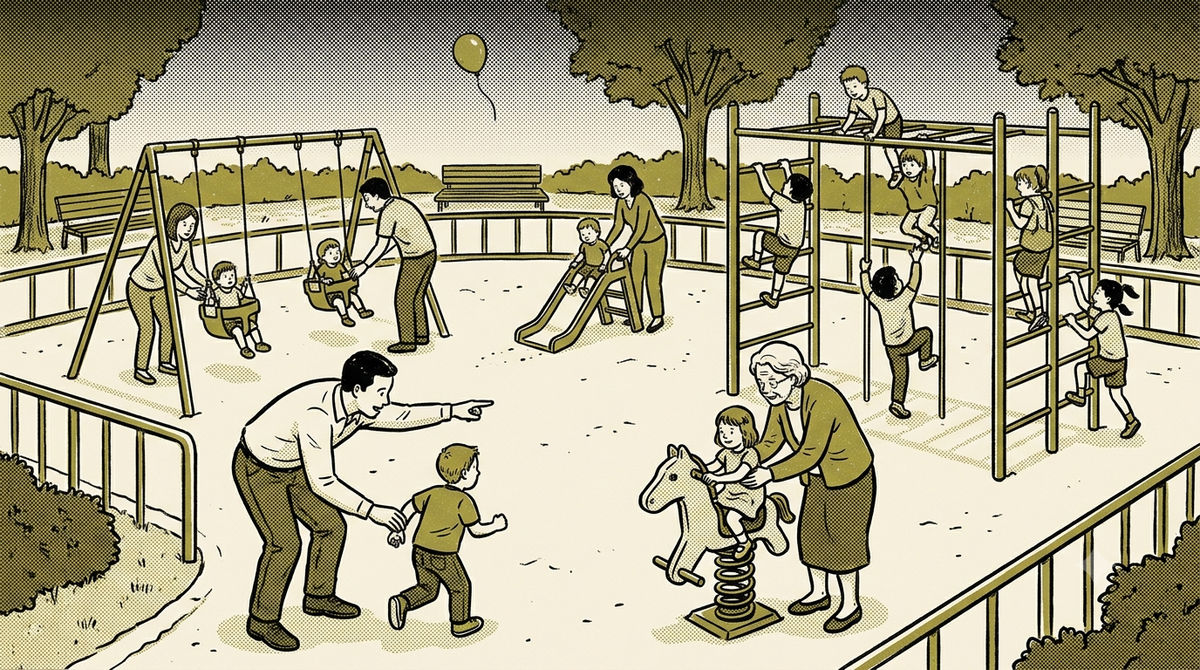
It is 6 pm at the colony park. The small toddler bay, two bucket swings, a knee-high slide, one spring rider, has a queue forming. On the spring rider a ten-year-old bounces hard, phone in hand, the spring bent sideways. A three-year-old waits at the edge, holding her grandmother's finger. Across the lawn the tall climbing frame, built for exactly this ten-year-old, sits empty.
What's actually happening
Playground equipment is made in age bands, and the bands are about safety, not decoration. The most detailed public guidance splits children into three groups: roughly 6 to 23 months, 2 to 5 years, and 5 to 12 years (Source: CPSC Public Playground Safety Handbook). The bucket swing has a deep seat so a one-year-old cannot slip out. The small slide has a low fall height because a four-year-old's bones are not a nine-year-old's. India has its own park-equipment standard, IS 6869, set for the same reason (Source: IS 6869 Part 1).
When a big kid takes over the small equipment, two things go wrong. The little ones who need it have nowhere to go. And the equipment, rated for a 20 kg child, takes a load it was never built for, which is how springs bend and bolts loosen for the next toddler.
The reverse matters too. A small child high on the tall frame, reaching for bars spaced for longer arms, is one slip from a fall the frame's height was never meant to soften. Falls are the leading cause of playground injury (Source: CPSC Public Playground Safety Handbook).
What works better
Match the child to the equipment. If your kid is past the toddler stage, the big frame is theirs, and usually more fun. If your kid is little, stay in the toddler zone and supervise within arm's reach.
If you are an older child or an adult, the small swings and spring riders are not yours, however free they look. Read the painted age range if there is one. If not, use the obvious test: would a three-year-old fit here, and are you bending it as you sit?
Take turns. A swing is for a few minutes, not the whole evening. When others wait, count down a fair go and rotate off. Teaching your child the handover is one of the more useful things they learn at the park.
Why it matters
A colony playground usually has one toddler swing for a neighbourhood full of toddlers. The supply was never going to match the demand, so the place runs on the same rotation as everything shared: use it, then free it.
Age-matched play is also how children stay safe and keep liking the park. A child who fell off equipment too big for them remembers the fall; one who got a fair turn comes back tomorrow. The small frame survived one more season because the big kids used the big frame. None of this needs a marshal. It needs the adults nearby to know which equipment is built for whom.
Try this next time
At the park, do one of these. Steer your older child to the equipment built for their size and leave the toddler bay to the toddlers. Set a turn limit on the popular swing and have your kid hand it over. Or, if a big kid is bending the small spring rider, a calm "that one is built for the little ones, the big frame is free" is usually enough.
Quick check
1. Your eight-year-old wants the toddler bucket swings. The big swings beside them are free, and two small children are waiting for the bucket swings. What is the move?
Select an answer.
2. Why is playground equipment split into age bands like 2 to 5 and 5 to 12 in the first place?
Select an answer.