Picking up after your dog (yes, even in India)
TL;DR
- Clip a roll of poop bags to the leash the way you clip the leash to the collar. In a week, bagging becomes a reflex.
- Dog waste is a water pollutant and carries Toxocara roundworm, whose eggs survive in soil for months and hit young children hardest.
- No bin in the park? Knot the bag and carry it home. A knotted bag does not smell, and 120 bags cost about ₹150.
- Bengaluru and Mumbai bye-laws already require owners to clean up, with municipal fines of ₹100 to ₹500.
Contents
The moment
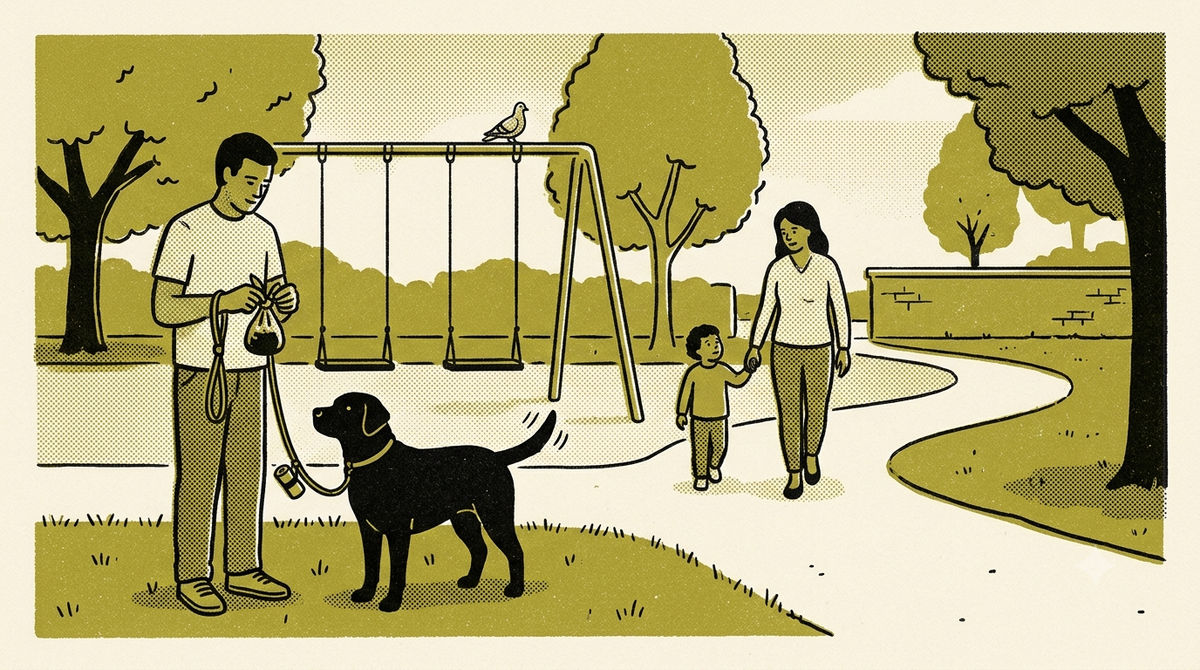
It is 6:45 am in the colony park. Your Labrador does his business on the grass strip near the children's swings, mid-walk, the way he does every morning. You have the leash in one hand and your phone in the other. Nobody is watching. The maali comes at eight. You give a small tug and walk on. Two hours later, a five-year-old sits on that grass.
What's actually happening
This is the most normalised pet-owner miss in India. Not malice, just a gap. You were never handed a bag, nobody around you carries one, and the park "gets cleaned anyway."
The structural failure is real. Most Indian parks have no dog-waste bins, no bag dispensers, no enforcement. But the gap does not answer the question the grass is asking. Someone walks, sits, or plays there after you. Right now, that someone inherits your dog's waste.
What works better
Carry bags. Clip a roll of poop bags to the leash, the way you clip the leash to the collar. It becomes automatic in a week. When your dog goes, you bag it, knot it, and carry it to a bin. If the park has no bin, the knotted bag rides home in your hand or a side pocket and goes into a bin there. A knotted bag does not smell. A pack of 120 bags costs about ₹150 online, which is roughly one rupee per walk.
Second-best, if you are caught without a bag: use a stick or a leaf to move the waste off the play surface. Push it into a planter bed or the compost corner, away from where people sit. Not ideal, but far better than leaving it on the swing-side grass.
Why it matters
Dog waste is not fertiliser. A single gram carries an average of 23 million fecal coliform bacteria. Left on the ground, it washes through storm drains into rivers and lakes. That drives the kind of bacterial contamination that makes water unfit for human contact (Source: Clean Water Campaign, Pet Waste Pollutes Our Rivers, Lakes and Streams). Rain does not dilute it. Rain delivers it.
The sharper reason is children. Dog faeces can carry the roundworm Toxocara, whose eggs survive in soil for months. A child playing in contaminated grass can swallow them, and the infection can travel to the eyes and other organs. It lands hardest on children aged two to seven (Source: CDC, How Toxocariasis Spreads). The swing-side grass is exactly where that risk waits.
Many Indian cities now put this in writing. Bengaluru's and Mumbai's bye-laws require owners to clean up after their dogs in public. Municipal fines run ₹100 to ₹500 (Source: Solid Waste Management Rules, 2016).
Try this next time
Tonight, clip a bag roll to the leash before the walk. For one week, bag every time, even when no one is watching, even when the park is empty. Notice how fast it stops being a decision and becomes a reflex. The dog is your responsibility, and so is what he leaves behind.
Quick check
1. Morning walk. Your dog goes on the park grass near the swings, you forgot bags, and nobody is around. What's the best move?
Select an answer.
2. Why is dog waste treated as a pollutant rather than fertiliser?
Select an answer.