Leashes, parks, and other people's children
TL;DR
- In any space where children play, keep your dog on a short leash, not a retractable one paid out to full length.
- Run the two-way ask: let a parent and child ask before they meet your dog, and you ask the parent before your dog greets their child.
- Children are the main dog-bite victims, not occasional ones. The WHO records 40 percent of suspected-rabid-animal bite victims are children under fifteen.
- Leashing in public is now law in a growing list of Indian cities, with Chandigarh's 2025 bye-laws capping leash length and fining violations.
Contents
The moment
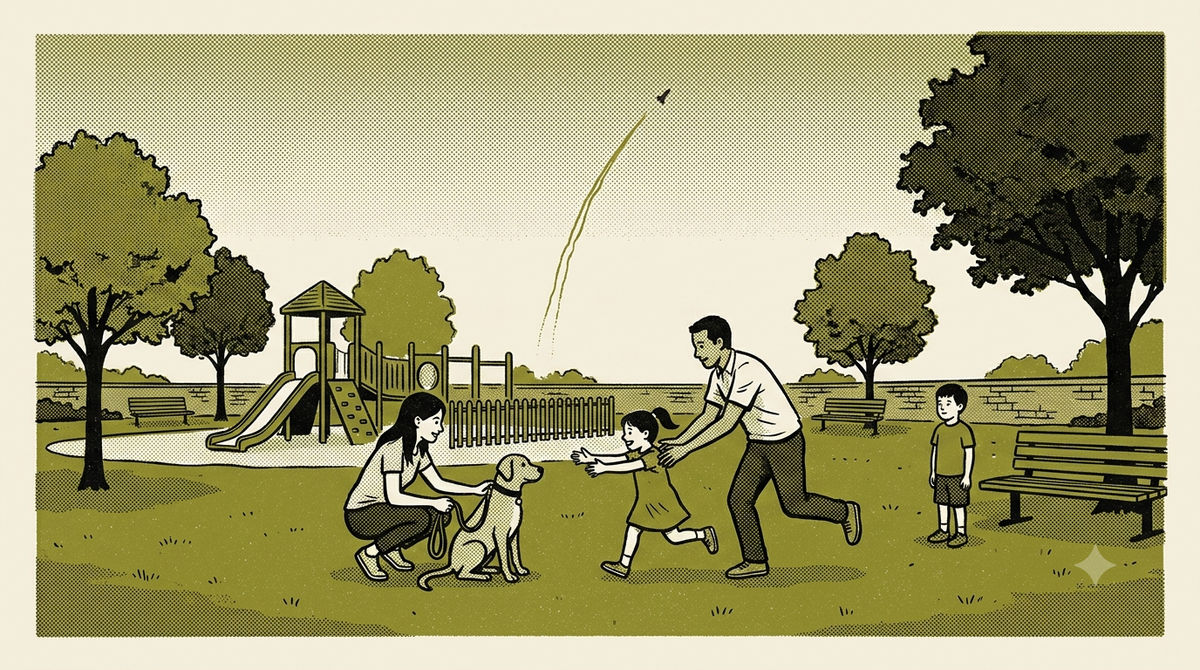
It is 5:30 pm at the neighbourhood park. Your dog is off the leash on the lawn, doing his usual loops. A four-year-old spots him, breaks from her mother, and runs straight at him with both arms out. At the same time, on the other side, a boy freezes mid-step and starts backing away. Your dog, delighted, cannot tell the two apart. You are thirty feet from all of it.
What's actually happening
A park lawn at evening is one of the few public spaces where dogs and other people's children share the same ten square metres. Both are moving on instinct. The running child assumes every dog wants a hug. The frozen child has learned the opposite. Your dog reads neither correctly, because reading small humans is not his job. It is yours.
Off the leash, you have handed the outcome to chance. Most of the time chance is kind and nothing happens. The problem is the tail. One evening the excited dog bowls the small child over. Or the scared child bolts and the dog gives chase. Or a grab at the tail earns a snap. None of that needs a mean dog. An ordinary friendly dog and an ordinary curious child are enough.
A retractable leash does not fix this. Five metres of thin cord is functionally off-leash in a crowd, with the bonus trick of tripping a passer-by.
What works better
In any space where children play, keep your dog on a short leash, roughly arm's length, not a retractable one at full run. That is the whole rule.
Then run the two-way ask. If a child wants to meet your dog, let the parent and child ask first. You answer honestly, either "yes, he's gentle, offer him your hand" or "not today, he's a bit much". If your dog wants to greet a child, you ask the parent, not the child. A four-year-old cannot consent for a nervous parent, and a nervous parent cannot always speak over an eager dog.
And teach the approach if the meeting is on. Hand out, palm down, let the dog come the last step. No hugging, no looming over, no grabbing the face or tail. Ten seconds, then move along.
Why it matters
Children are not occasional dog-bite victims. They are the main ones. The World Health Organization records that 40 percent of people bitten by suspected rabid animals are children under fifteen (Source: WHO, Rabies). They are small, face-height to a dog, and quick to reach out. The leash is the cheapest insurance against your dog becoming that story.
It is also the law in a growing list of cities. Chandigarh's 2025 pet bye-laws require dogs in public to be leashed and cap the leash length, with fines reaching thousands of rupees (Source: The Tribune). Most Indian municipal pet rules now say some version of the same thing.
The quieter payoff is the frozen child. Every calm, leashed, well-managed meeting is one more child who keeps liking dogs. Your leash is doing that too.
Try this next time
At the park gate, clip the leash short and keep it short until you are past the play area. When a child comes running, put a hand on the collar and let the parent catch up. One short leash, one ask, one gentle sniff. The freedom your dog loses is small. The trust the park keeps is not.
Quick check
1. At the park, a small child breaks away from her parent and sprints straight at your off-leash dog with both arms out. What is the best default?
Select an answer.
2. Why do dog-behaviour and public-health guides treat children as the highest-risk group around dogs?
Select an answer.